Get a vietnamese IP address
A practical guide to obtaining a Vietnamese IP address for browsing, work, or testing needs.
Getting a Vietnamese IP address means you can appear as if you’re browsing from Vietnam. This can help with region-locked content, local market research, or testing apps and websites from a Vietnamese network. There are several reliable approaches, each with its own trade-offs in speed, privacy, and cost. Below, you’ll find practical options, how they work, and tips to choose the right method for your needs.
Understanding why you might want a Vietnamese IP address
- Access Vietnamese services: Some sites restrict content to users inside Vietnam. A Vietnamese IP can unlock features, pricing, or content catalogs.
- Price and localization tests: Businesses often test how pricing, localization, and user experience look from Vietnam.
- Latency considerations: If you’re physically near Vietnam, routing via a Vietnamese IP can reduce hops and improve response times for regional users.
- Compliance and analytics: Some analytics tools differentiate traffic by region. A Vietnamese IP helps you simulate local traffic.
VPNs: the most common route to a Vietnamese IP
VPNs are widely used to get a Vietnamese IP address quickly and with relatively low effort. They route your internet traffic through a remote server in Vietnam, masking your real location.
Pros
- Easy setup on most devices (Windows, macOS, iOS, Android).
- Often affordable with monthly plans.
- Wide selection of Vietnamese servers from reputable providers.
Cons
- Variable speed depending on the server load.
- Some streaming services actively block VPNs.
- Trust and privacy depend on the VPN provider’s logging policy.
What to look for in a VPN for Vietnam Get a US IP address
- Servers in Vietnam: Prefer providers with at least one or more dedicated Vietnam locations.
- No-logs policy: Check independent audits or reputable reviews.
- Speed and reliability: Look for high bandwidth plans and low latency.
- Kill switch and DNS leak protection: Safeguards your real IP if the VPN disconnects.
- Customer support and uptime guarantees.
How to set up
- Choose a VPN with a Vietnam server.
- Install the app on your device.
- Connect to a Vietnam server.
- Verify your IP by visiting a site like whatismyipaddress or ipinfo.io.
Proxies: lightweight and flexible for targeted tasks
Proxies can be a cheaper or more granular option when you need a Vietnamese IP for a specific app or task, rather than all traffic.
Types of proxies
- HTTP/HTTPS proxies: Good for web browsing and APIs. Easy to configure in browsers.
- SOCKS5 proxies: More versatile for varied applications and platforms.
- Residential proxies: Use real devices in Vietnam. Higher cost but less block risk.
- Datacenter proxies: Affordable but more easily detected by services.
Pros Get a ukrainian IP address
- Fine-grained control: Use a Vietnamese proxy for a single application.
- Cost options: Ranges from cheap to premium, depending on reliability.
Cons
- Generally less secure than VPNs if not encrypted.
- Some sites block proxies or require CAPTCHA challenges.
- Proxy reliability varies. Rotating proxies can mitigate bans but adds complexity.
Best practices
- Use HTTPS/SSL proxies when possible to encrypt traffic.
- Prefer rotating proxies only if you need frequent IP changes and understand the setup.
- Pair with a secure browser extension or application configuration to ensure traffic routes as intended.
Cloud servers and VPS: permanent Vietnamese IPs for testing and hosting
If you need a stable, business-grade Vietnamese IP (e.g., for testing, automation, or hosting a service), a virtual private server (VPS) or cloud instance in Vietnam is a solid option.
Where to get Vietnamese IPs Get a UK IP address
- Local cloud providers: Some Asia-Pacific providers offer data centers in Vietnam.
- Global cloud platforms: Major providers (AWS, Google Cloud, Microsoft Azure) may have Vietnam regions or nearby zones with outbound IPs that appear Vietnamese if the network routing is set up accordingly.
- Dedicated servers: For high control and fixed IPs, though often more expensive.
Pros
- Stable, fixed IP addresses for long-term use.
- Full control over the server environment.
- Suitable for automated tests, staging environments, or API endpoints.
Cons
- Higher cost than consumer VPNs or proxies.
- Requires server management knowledge (security, updates, backups).
- Latency depends on your location relative to the data center.
Use cases
- API testing from a Vietnamese origin to simulate local clients.
- Hosting a microservice that must appear local to Vietnamese users.
- Secure background tasks that require a persistent Vietnamese endpoint.
Mobile data and SIM-based approaches
If you specifically need a Vietnamese IP on mobile devices, consider SIM-based roaming options or Vietnamese mobile carriers that provide international data roaming. Get a tuvaluan IP address
Pros
- Natural and consistent IP in mobile networks.
- Useful for app testing on mobile devices.
Cons
- Often expensive for long-term use.
- IPs can change with roaming sessions or be shared among many users.
- More challenging to configure for desktop workflows.
When to consider mobile-based approaches
- You’re primarily testing mobile apps or mobile web experiences.
- You need to simulate real device conditions in Vietnam.
Table: compare options at a glance
| Method | Typical Use Case | Pros | Cons | Typical Cost |
|---|---|---|---|---|
| VPN | General browsing, remote work | Easy setup, global coverage | Possible blocks; speed depends on server | Moderate |
| Proxies | Targeted apps, API calls, automation | Flexible, granular control | Security depends on proxy; blocks possible | Low to moderate |
| Cloud VPS | Long-term testing, hosting, automation | Permanent IP, full control | Higher cost, server management | Moderate to high |
| Mobile data | Mobile app testing, device realism | Real mobile IP; mobile network context | Expensive for long-term use | Moderate to high |
Privacy, legality, and best practices
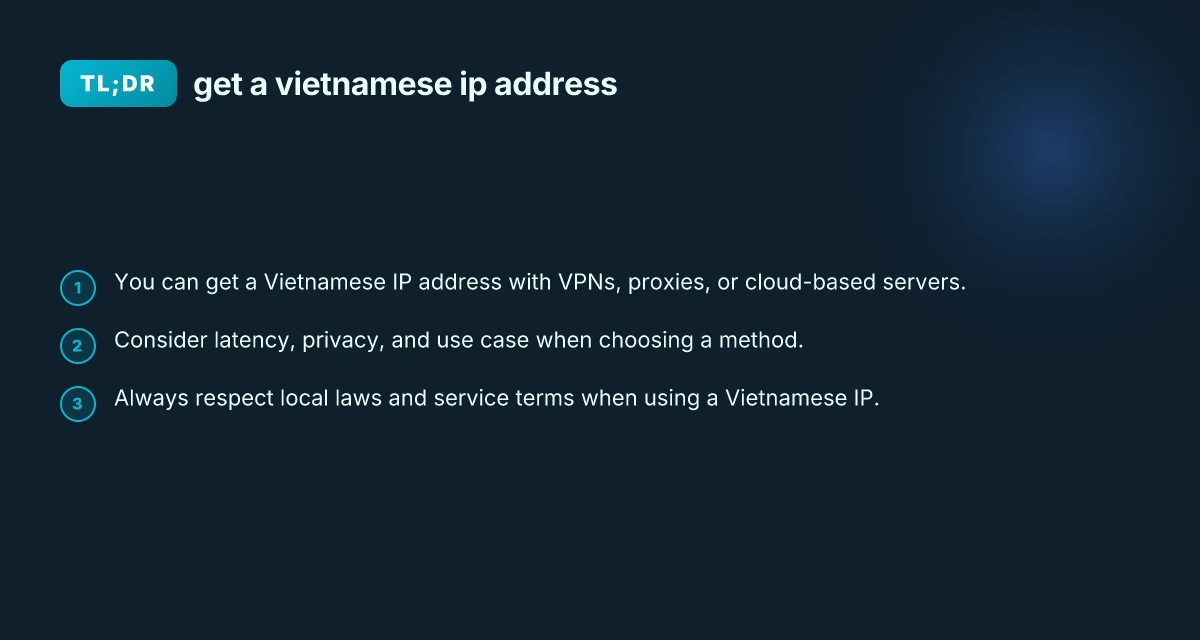
- Respect terms of service: Some sites prohibit the use of VPNs, proxies, or simulated geographic IPs. Always read the terms of service before attempting access.
- Privacy trade-offs: VPNs provide encryption but still require trust in the provider. Proxies may log traffic unless you encrypt end-to-end.
- Data sovereignty: Vietnam’s data laws can affect what data you’re allowed to transfer or store in-country. Ensure your use case complies with local regulations.
- Security hygiene: Use strong authentication, keep software up to date, and avoid exposing sensitive data over untrusted proxies.
How to choose the right method for you
- Define your goal: Content access, testing, or hosting? Your goal determines the method.
- Consider duration: Short-term testing can be VPN or rotating proxies. Long-term projects benefit from a VPS.
- Evaluate latency tolerance: If you need near-native speed, a local Vietnam-based server reduces hops.
- Assess risk posture: If privacy and data protection are paramount, prioritize trusted VPNs or managed VPS with good security practices.
- Budget and maintenance: VPNs are usually cheaper and easier; VPS involves maintenance overhead.
Practical setup checklist
- For VPN: Pick a reputable provider with Vietnam servers, enable kill switch, and perform IP verification after connection.
- For proxies: Decide on proxy type (HTTP(S) vs SOCKS5. Rotating vs static). Configure in the target app and test connectivity with a Vietnamese IP check site.
- For VPS: Choose a Vietnam region if available, secure the server, install your required software, and set up firewall rules and monitoring.
- For mobile: If you must use Vietnam IP on mobile, review roaming plans and consider combining with VPN for consistent security.
Final recommendation
If your primary need is quick access to Vietnamese content, testing, or regional research with minimal setup, start with a reputable VPN that offers Vietnam servers and a clear no-logs policy. It provides a good balance of privacy, ease of use, and cost. If you require a stable, long-term endpoint for automated tasks or hosting, invest in a VPS or cloud instance in or near Vietnam to ensure a consistent Vietnamese IP and predictable performance. Get a turkish IP address
If you have a specific use case (e.g., streaming access, API testing, or enterprise-grade hosting), I can tailor recommendations to your exact requirements, including provider suggestions, pricing tiers, and step-by-step setup guides.