Iaps security store: securing in-app purchases and protecting user data
A practical guide to iaps security store practices, threats, and defenses for developers and security-conscious teams.
In-app purchases (IAPs) are a core revenue channel for many apps, but they also introduce a set of security challenges. An IAP security store mindset means you treat every purchase path as a potential attack surface and build defenses accordingly. This article dives into what to know about securing IAPs, the threats to watch for, and the practical steps you can take to strengthen your app’s defenses without sacrificing user experience.

Understanding the IAP security landscape
IAPs involve client-side actions, server-side validations, financial data handling, and user credentials. The security of an IAP system rests on several layers:
- The communication channel between the app and your servers.
- The merchant validation performed by the platform (Apple App Store, Google Play, etc.).
- The server that issues and verifies receipts or purchase tokens.
- The backend services that grant access to digital goods or services.
Common missteps include trusting the client, skipping receipt validation, or relying on weak encryption. A secure IAP flow should ensure that purchases are validated on a trusted side, that receipts cannot be easily forged, and that follow-up authorization and access control controls are enforced.
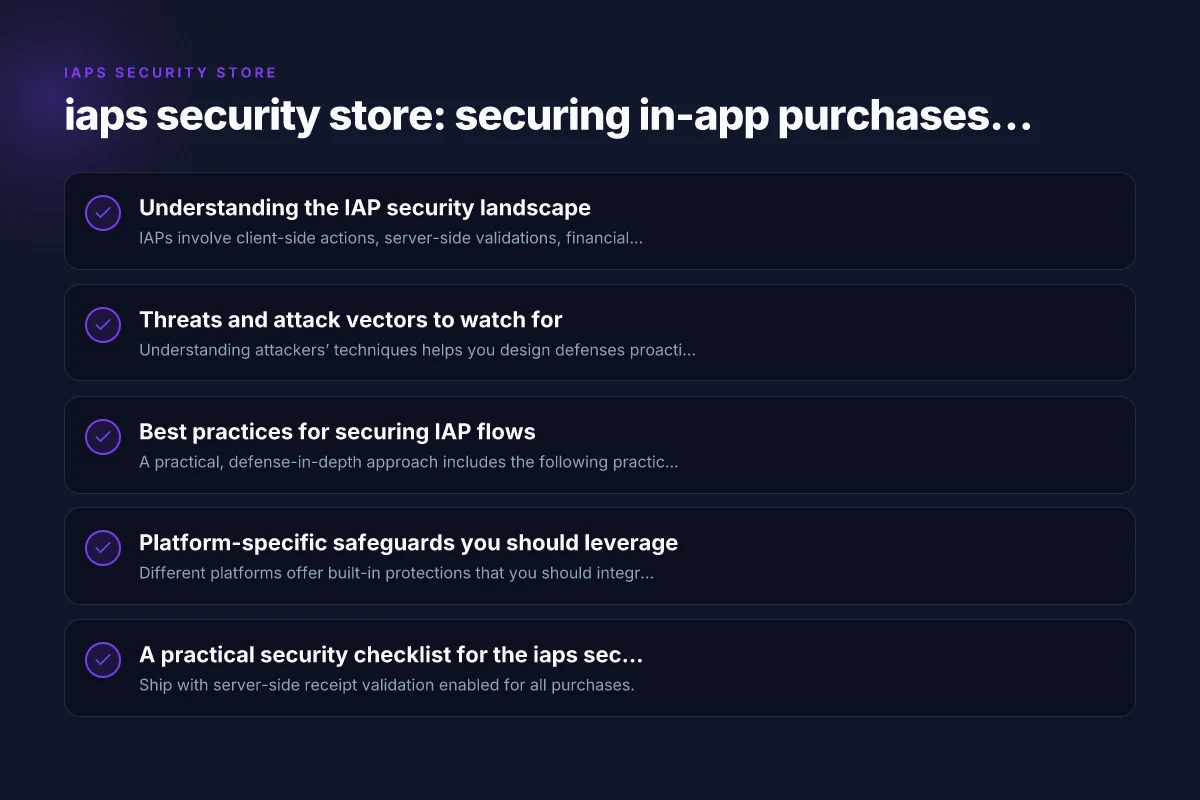
Threats and attack vectors to watch for
Understanding attackers’ techniques helps you design defenses proactively. Some core threats include:
- Receipt tampering: Malicious users try to fake purchase receipts or replay old tokens.
- Replay attacks: An attacker resubmits a valid receipt to gain access repeatedly.
- Server-side credential leakage: Secrets used to validate purchases are exposed in the client or in build artifacts.
- Man-in-the-middle (MITM) attacks: Insecure connections allow eavesdropping or modification of purchase data.
- Refund and entitlement abuse: Users keep access after refunds or manipulate entitlement logic.
- Inadequate platform verification: Relying only on client-side checks or bypassing platform safeguards.
To mitigate these, you should enforce receipt validation on a trusted server, pin TLS where possible, and implement strong entitlement checks. How to mask your IP address and why
Best practices for securing IAP flows
A practical, defense-in-depth approach includes the following practices:
Use server-side receipt validation
Validate receipts/tokens with official platform servers (Apple's verifyReceipt, Google Play Purchase Verify).
Implement robust error handling for declined or invalid receipts. How to hide your IP address online
Cache validation results and set reasonable TTLs to minimize repeated requests.
Secure communications
Enforce TLS 1.2+ for all network traffic.
Use certificate pinning where feasible to reduce MITM risk. How to hide your IP address on the internet
Avoid exposing secret keys or API endpoints in the client.
Protect and rotate credentials
Store API keys, shared secrets, and certificate data securely (e.g., in a secrets manager, not in the app bundle).
Rotate credentials regularly and audit access. How to get a US IP address
Robust entitlement and access controls
Tie each purchase to a real entitlement in your backend.
Re-check entitlements on critical actions and after server restarts or app reinstalls.
Consider time-based or renewal-based entitlements for consumables and subscriptions. How to find a good proxy site
Abuse detection and rate limiting
Monitor for unusual purchase patterns, such as rapid-fire checks, suspicious IPs, or user-agent anomalies.
Implement rate limits on purchase verification endpoints.
Obfuscation and defense-in-depth How to change your country IP address
While not a substitute for secure design, code obfuscation and integrity checks can deter casual tampering.
Separate business logic from the app core to make local tampering harder.
Logging and observability
Log receipt validation results, error codes, and anomalies in a privacy-conscious way. Ibvpn: What Ibvpn Is, How It Works, and When to Use It
Maintain alerting for repeated validation failures or abnormally high refund activity.
Testing and QA
Include security-focused tests in your CI pipeline.
Use test accounts for sandbox environments to validate edge cases (expired receipts, revoked licenses, etc.). Internet censorship: what it is, why it happens, and how to navigate it
Platform-specific safeguards you should leverage
Different platforms offer built-in protections that you should integrate into your IAP security program.
Apple App Store (iOS)
Use Apple’s App Store receipt validation (server-side) to verify purchases.
Validate the receipt’s bundle ID, product ID, and transaction IDs. IP address changing program
Implement automatic receipt refresh flow for users who restore purchases.
Google Play (Android)
Use Google Play Developer API for purchase verification and subscription status.
Validate purchases against Google Play servers and keep their status in sync with your backend. IP address hiding software
Consider PKCE for any mobile OAuth flows and secure server-to-server calls.
Cross-platform considerations
If you offer cross-platform purchases, ensure your backend can reconcile receipts from both ecosystems.
Use consistent entitlement schemas so that platform differences don’t create gaps that attackers can exploit. IP vanish
A practical security checklist for the iaps security store
- Ship with server-side receipt validation enabled for all purchases.
- Implement TLS with pinning and monitor TLS configuration regularly.
- Keep secrets out of the app. Use a secure vault or secret management system.
- Enforce entitlements on the backend. Never rely solely on client-side checks.
- Implement retry and backoff policies for receipt validation to avoid abuse.
- Add monitoring for suspicious patterns around purchases and refunds.
- Perform regular security testing, including fuzz tests and penetration tests focusing on IAP paths.
- Maintain a documented incident response plan for IAP-related breaches or abuse.
- Review and rotate API keys and credentials on a cadence aligned with your risk posture.
A simple comparison: client-side vs server-side validation
| Aspect | Client-Side Validation | Server-Side Validation (Recommended) |
|---|---|---|
| Trust level | Low; easy to bypass | High; authoritative |
| Exposure to tampering | High | Low |
| Latency impact | Low to moderate | Moderate (depends on network) |
| Implementation complexity | Simple | Moderate to complex (requires backend) |
| Recommended posture | Use only for UI signals and quick checks | Core of the IAP security model |
Real-world patterns: what good IAP security looks like
- A shopper completes a purchase in the app.
- The app sends the receipt/token to your backend over TLS.
- The backend validates the receipt with the platform’s server, confirms product entitlement, and issues a server-side token or grant.
- The app requests access to the entitlement, and the backend enforces it on all sensitive actions.
- The backend monitors validation results and flags anomalies for review.
In this pattern, even if someone tries to fake a receipt on the client, the server-side validation and entitlement enforcement keep abuse in check. The goal is to design so that client-side manipulation cannot grant access to paid features.
How to measure and improve over time
- Track success metrics: successful validations, failed validations, time-to-fulfillment, and refund-related anomalies.
- Audit logs and anomaly detection: set up dashboards that highlight unusual patterns in purchases or entitlement grants.
- Regular threat modeling: revisit your IAP flows after major app updates, platform changes, or new features.
- Security hygiene: perform periodic secrets refresh, rotate keys, and update libraries to the latest secure versions.
Final recommendation
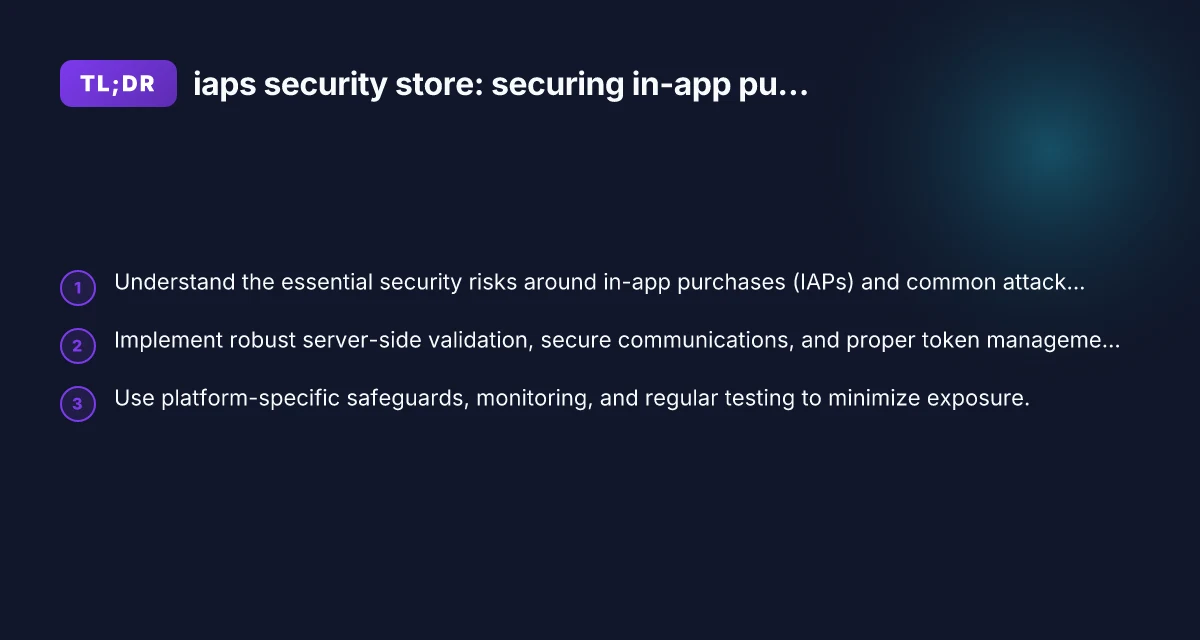
If you want a concise, action-focused stance: treat IAP security as a server-centric discipline. Validate receipts on trusted servers, enforce entitlements server-side, and secure the entire communication path with modern TLS and credentials management. Leverage platform protections, stay vigilant with threat monitoring, and continuously test your flows. This approach minimizes the risk of abuse while preserving a smooth purchase experience for users.