Get a chinese IP address in Germany

Learn practical ways to get a Chinese IP address while you’re in Germany, including VPNs, proxies, and legal considerations.
Getting a Chinese IP address while you’re in Germany is a common need for accessing Chinese services, testing websites, or enjoying content tied to mainland China. There are legitimate and reliable ways to achieve this, typically by using a VPN, a proxy, or a cloud-based server located in China. This article walks you through practical options, how they work, what to look for, and the potential trade-offs. It also covers legal and security considerations so you can make an informed choice.

Why you might want a Chinese IP in Germany
- Access mainland China-only services, apps, or websites
- Test your site or app as a user in China
- Bypass regional restrictions for business or research
- Conduct market or localization checks with a Chinese IP
- Maintain privacy and security when connecting to Chinese resources
However, there are important caveats:
- Not all methods guarantee reliable, consistent access
- Some services may detect and block VPNs or proxies
- Data privacy and compliance vary by provider and jurisdiction
- Using a Chinese IP to violate terms of service can lead to account restrictions
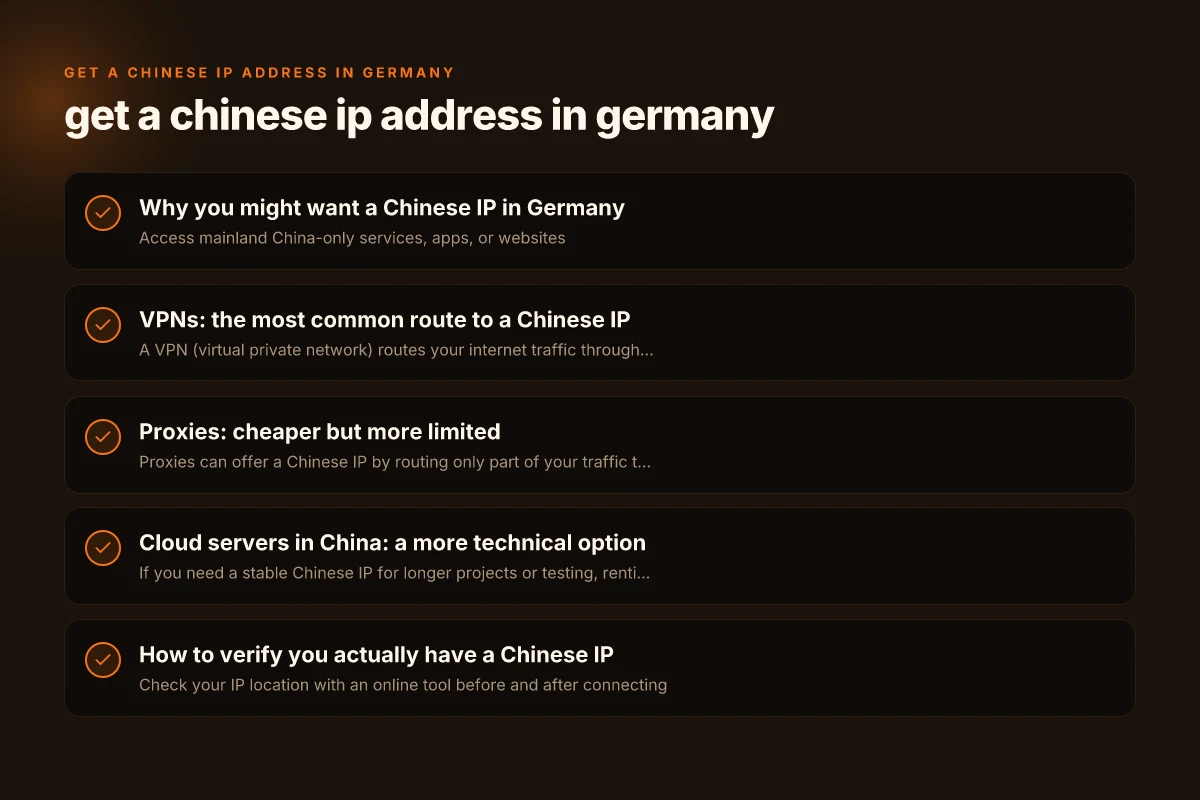
VPNs: the most common route to a Chinese IP
A VPN (virtual private network) routes your internet traffic through a server located in another country, giving you an IP address from that country. For China, you’ll want a VPN that specifically offers servers in mainland China or close-by regions and provides reliable, fast connections.
Choosing a VPN with Chinese servers
- Server availability: Mainland China (often difficult due to regulatory constraints) vs. nearby regions like Hong Kong or Singapore
- Protocols: OpenVPN, WireGuard, or IKEv2 for a balance of speed and security
- Connection speed: Look for providers with high-throughput servers
- Privacy policy: Clear data handling and no-logs guarantees
Pros and cons of VPNs for a Chinese IP
- Pros:
- Easy, user-friendly apps for desktop and mobile
- Flexible: switch servers to change IP location
- Strong encryption and security features
- Cons:
- Mainland China server access can be limited or unstable
- Some services detect and block VPNs
- Potentially slower speeds due to long-distance routing
What to look for when evaluating VPNs
- China-specific servers or edge servers (Hong Kong/Singapore) that reliably present mainland China IPs
- Obfuscated or Stealth mode options to bypass VPN blocks on certain networks
- Kill switch, DNS leak protection, and robust encryption
- Transparent privacy policies and independent audits if possible
- Transparent customer support with rapid response times for China-related issues
Proxies: cheaper but more limited
Proxies can offer a Chinese IP by routing only part of your traffic through a Chinese endpoint. They are generally less secure than VPNs and may not protect all traffic, which can reveal your real location.
When proxies are appropriate
- Quick access to a single service or website
- Lightweight tasks that don’t require full device routing
- Scenarios where you don’t need strong encryption
Caveats
- Lower security and potential data exposure
- Higher risk of leaks if misconfigured
- Not ideal for sensitive tasks like banking or login credentials
- Many services detect proxy usage and block access
Cloud servers in China: a more technical option
If you need a stable Chinese IP for longer projects or testing, renting a cloud server in China can be an effective solution. This approach involves setting up a server that acts as a gateway or remote environment with a Chinese IP. Get a Chilean IP address: how to access Chile with a VPN or proxy
How it works
- Rent a virtual private server (VPS) located in China
- Connect via SSH or remote desktop
- Use the server’s network path to access Chinese services
- Optional: set up a VPN or SSH tunnel to route traffic from your devices through the Chinese server
Pros and cons
- Pros:
- Very reliable Chinese IP
- High control and flexibility
- Suitable for long-term research, testing, or automation
- Cons:
- More technical setup and ongoing maintenance
- Compliance with Chinese laws and service terms
- Potential data protection and privacy concerns
- Higher cost than consumer VPNs
How to verify you actually have a Chinese IP
- Check your IP location with an online tool before and after connecting
- Examples: whatismyipaddress, iplocation.net, or your VPN’s own test page
- Run a service-specific check
- If you’re testing a website, ensure you’re seeing content as it appears to users in China
- Look for latency and routing indicators
- A Chinese IP will often show higher latency if you’re physically distant, but you’ll route traffic through mainland China or nearby hubs
A practical comparison: VPNs vs proxies vs cloud servers
Here is a quick comparison to help you decide which approach fits your needs.
VPNs (Chinese or nearby servers)
Security: High (encryption)
Reliability: Moderate to high, depending on provider Get a canadian IP address
Ease of use: High
Cost: Medium
Best for: Regular access, privacy, and varied tasks
Proxies Get a cameroonian IP address
Security: Low to medium (no encryption)
Reliability: Variable
Ease of use: Medium
Cost: Low Get a cambodian IP address
Best for: Light, quick access to a single service
Cloud servers in China
Security: Medium to high (depends on configuration)
Reliability: High Get a bulgarian IP address: practical ways to appear as if you’re browsing from Bulgaria
Ease of use: Low to medium (technical)
Cost: Medium to high (ongoing)
Best for: Long-term testing, automation, and scenarios needing a true Chinese IP
Table: quick side-by-side at-a-glance Get a brazilian IP address
| Method | Security | Reliability | Ease of Use | Best For |
|---|---|---|---|---|
| VPN (China/nearby) | High | Moderate-High | High | Regular access, privacy, testing across services |
| Proxy | Low-Medium | Variable | Medium | Quick, lightweight access to individual sites |
| Cloud server in China | Medium-High (depends on config) | High | Low-Medium | Long-term testing, automation, dedicated Chinese IP |
Legal and policy considerations
Accessing content or services with an IP from a different country can bring legal and policy implications. Here are key points to keep in mind:
- Terms of service: Many platforms prohibit circumvention of geo-restrictions or use of VPNs. Violating terms can lead to account suspension or loss of access.
- Local laws: Using tools to mask your location may be restricted in some jurisdictions or under specific circumstances. Ensure you understand the rules in both Germany and China where applicable.
- Data privacy: When using VPNs or proxies, your data can be routed through third-party servers. Read privacy policies and consider providers with independent audits.
- Compliance: If you’re handling sensitive data or business information, ensure your approach complies with data protection regulations (e.g., GDPR in Germany) and any cross-border data transfer considerations.
Practical steps to get started
- Define your goal
- Are you testing a site, accessing content, or performing automation?
- Do you need long-term access or just occasional use?
- Choose a method
- For everyday use and strong privacy: a reputable VPN with Chinese or near-China servers
- For quick single-site access: a proxy could suffice
- For robust, long-running tasks: a China-based cloud server with a configured gateway
- Research providers
- Look for transparent privacy practices, clear server locations, and good customer support
- Read recent reviews about China connectivity and reliability
- Test and verify
- Check your IP location before and after connection
- Run your intended service or workflow to confirm access and performance
- Monitor legality and policy
- Review terms of service for the sites you access
- Stay compliant with local and international regulations
Practical tips to optimize your experience
- Use reputable providers with clear no-logs policies if privacy is important
- Enable features like DNS leak protection and a kill switch on VPNs
- Consider multi-hop VPNs or obfuscated servers if you’re on networks that block VPNs
- Keep software up to date to minimize security vulnerabilities
- If latency is a concern, connect to the closest suitable Chinese or regional server and optimize routing on your device
Final recommendation
For most users who want a reliable Chinese IP address while in Germany, start with a reputable VPN that explicitly offers access to mainland China or nearby regions and provides strong encryption, a kill switch, and good customer support. If you need a highly stable and long-term Chinese IP for testing or automation, a cloud server hosted in China can be a powerful option, but be prepared for more technical setup and higher ongoing costs. Proxies are best reserved for quick, low-risk tasks where security is not a primary concern.
If you’re unsure which route fits your needs, consider starting with a trial of a well-known VPN that supports China or nearby servers, verify you can securely access the required services, and then evaluate whether you need to scale to a dedicated cloud server for more complex workflows.