Get a brazilian IP address
Learn practical ways to get a Brazilian IP address, with pros, cons, and tips for staying secure.
The internet is global, but many services behave differently depending on your location. If you need a Brazilian IP address, whether for accessing region-locked content, testing apps, or browsing as if you were in Brazil, you have several practical paths. Each method has its own benefits and drawbacks, so the best choice depends on your needs, budget, and risk tolerance. Below you'll find straightforward options, how they work, and what to watch out for.
Why you might want a Brazilian IP address
- Access region-locked streaming libraries, banking services, or online content that favors Brazil.
- Test websites or apps from a Brazilian IP to ensure regional behavior, localization, and performance.
- Preserve privacy or reduce tracking by using a different geographic IP, while noting that not all methods guarantee anonymity.
- Explore Brazilian markets, price differences, or regional promotions that are tied to location.
Important considerations
- Some services actively block VPNs and proxies, so you may need to switch servers or providers.
- Using geo-restricted services may violate terms of service. Proceed with awareness of potential account risks.
- Free options exist, but they come with limits on speed, data, and reliability and can pose privacy risks.
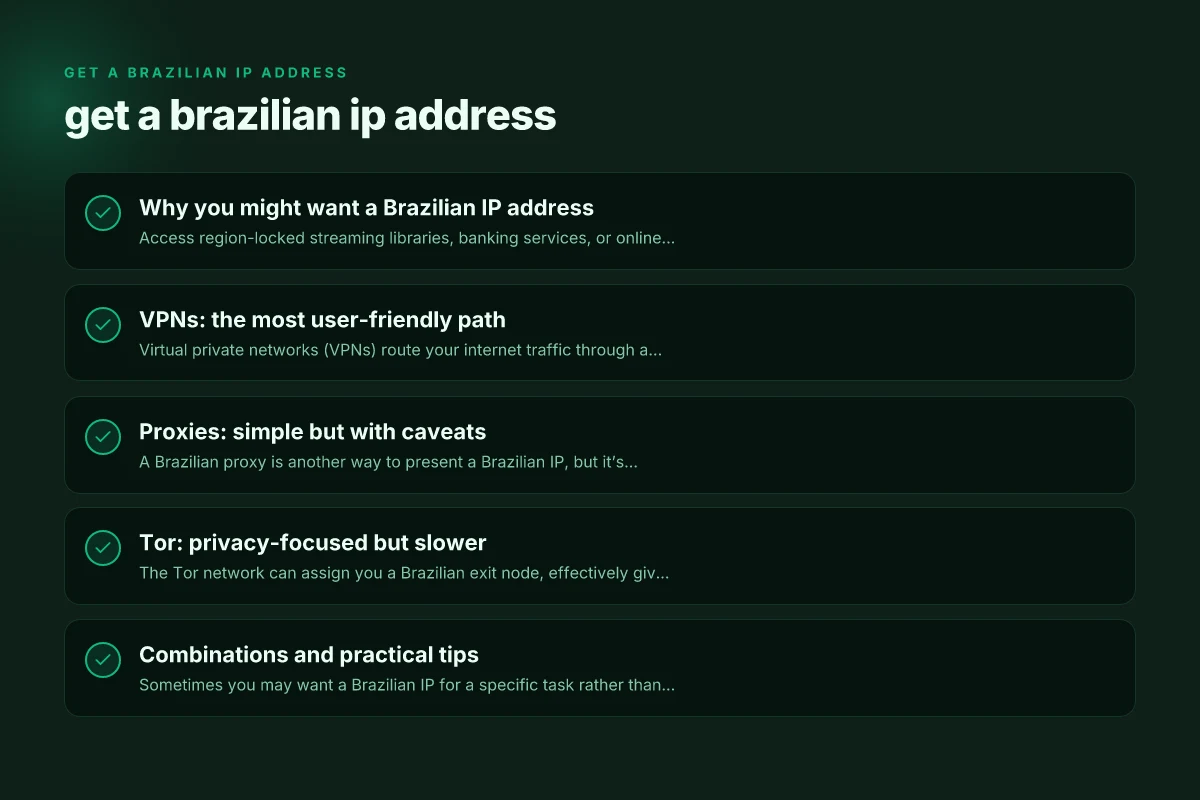
VPNs: the most user-friendly path
Virtual private networks (VPNs) route your internet traffic through a server in Brazil, giving you a Brazilian IP address and encrypting your connection.
- How it works: Your device connects to a Brazilian VPN server, which then communicates with the internet on your behalf.
- Pros: Easy to set up, broad server coverage in Brazil, strong encryption, reliable for streaming and browsing.
- Cons: Some streaming services detect and block VPNs. Performance depends on server load and distance.
- Best practices:
- Choose a reputable VPN with Brazil servers, a no-logs policy, and strong encryption.
- Test multiple Brazilian servers to find the fastest one for your location.
- Enable kill switch and leak protection to prevent IP leaks if the VPN drops.
- Check service terms to ensure you’re compliant with their policies.
How to choose a VPN for Brazil
- Server network: A wide range of Brazilian cities is a plus.
- Speed: Look for providers offering fast hardware and optimized routes.
- Privacy: A transparent privacy policy and independent audits help.
- Compatibility: Works on your devices (Windows, macOS, iOS, Android, Linux, routers).
- Support: Live chat or quick ticketing for troubleshooting.
Proxies: simple but with caveats
A Brazilian proxy is another way to present a Brazilian IP, but it’s typically less secure than a VPN.
- How it works: Your traffic is routed through a proxy server located in Brazil. Some proxies are open (free), while others are paid.
- Pros: Often cheaper than VPNs, easy to configure for browsers.
- Cons: No end-to-end encryption (many are HTTP rather than HTTPS), higher risk of data interception on free proxies, more easily blocked by services.
- Best use cases: Quick checks of geolocation-based content without needing full device-wide protection.
- Tips:
- Prefer HTTPS proxies to encrypt traffic to the proxy, reducing eavesdropping.
- Avoid free proxies for sensitive activities like banking or logins.
- Use proxies mainly for browser traffic when you don’t need system-wide routing.
Tor: privacy-focused but slower
The Tor network can assign you a Brazilian exit node, effectively giving you a Brazilian IP, but with notable trade-offs.
- How it works: Your traffic is relayed through multiple volunteer servers, with traffic exiting via a Brazilian node if available.
- Pros: Strong anonymity properties, low risk of centralized data collection.
- Cons: Significantly slower speeds due to multiple hops. Some sites block Tor traffic. Not ideal for streaming or heavy downloads.
- Best use cases: Anonymous browsing, research, or testing location-sensitive behavior without revealing your true IP.
- Tips:
- Use Tor Browser for best compatibility and security.
- Pair with bridge or fingerprint-resistant settings if you need extra privacy.
- Expect higher latency. Don’t rely on Tor for real-time video.
Combinations and practical tips
Sometimes you may want a Brazilian IP for a specific task rather than all traffic routing through Brazil. Get a bolivian IP address
- Browser-only approach: Use a Brazilian proxy or VPN extension in your browser to localize only that traffic.
- Device-wide approach: Use a VPN to cover all apps and services on your device for a consistent Brazilian IP.
- Mixed approach: Use Tor for privacy-sensitive tasks and a VPN for streaming or testing, ensuring you don’t run into conflicts or leaks.
- Security notes:
- Always use HTTPS when possible to protect data from interception, especially on proxies.
- Keep software up to date to mitigate leaks and vulnerabilities.
- Test for IP leaks (WebRTC, DNS) to confirm the Brazilian IP is actually in use.
Quick comparison: VPN vs Proxy vs Tor
| Method | Brazilian IP reliability | Speed | Encryption | anonymity | Use case examples |
|---|---|---|---|---|---|
| VPN | High | Fast to moderate | Strong | High | Streaming, secure browsing, geo-locked content access |
| Proxy | Moderate | Fast (free options slow) | Often none or limited | Low to moderate | Quick browser access, light testing |
| Tor | Variable (can be Brazilian exit) | Slow | End-to-end (onion routing) | High | Anonymity-focused browsing, location testing with low risk to identity |
Privacy, legality, and terms of service
- Legality: In most places, using a VPN or changing your visible location is not illegal, but certain activities may still violate laws or terms of service. Always stay within the law and review terms for banking, streaming, and login behavior.
- Terms of service: Many streaming platforms ban or restrict VPN usage. If you rely on streaming, be prepared for possible blocks or account holds.
- Data privacy: A reputable VPN provider should have clear data practices, preferably a no-logs policy. Read privacy policies and consider independent audits if privacy is a priority.
- IP leaks: DNS leaks or WebRTC leaks can reveal your real location even when using a VPN. Use built-in protections and test regularly.
Getting set up: a quick-start guide
- Decide your primary goal: streaming, testing, privacy, or general browsing.
- Pick your method: VPN for most users, proxy for quick browser tasks, Tor for privacy.
- Choose a provider or service with Brazil servers and a solid privacy track record.
- Install and configure:
- VPN: Install app, log in, connect to a Brazilian server, enable kill switch.
- Proxy: Configure browser or system proxy settings for a Brazilian proxy server. Prefer HTTPS proxies.
- Tor: Install Tor Browser and connect to a Brazilian exit node if available (note: not always reachable).
- Verify your IP: Use an IP-checking site to confirm you appear as from Brazil.
- Test the experience: Check streaming quality, access to region-locked sites, and latency.
Best practices for reliability and safety
- Use trusted providers: Read reviews, look for transparent privacy policies, and verify no-logs claims.
- Protect against DNS and WebRTC leaks: Enable built-in protections in your browser and VPN.
- Keep a backup method: If your primary Brazilian IP is blocked, know alternative servers or methods.
- Be mindful of data limits: Some free options restrict data usage, speeds, or both.
- Regularly review permissions: For mobile apps, ensure no unnecessary permissions are active that could reveal your location.
Final recommendation
If your goal is a reliable Brazilian IP for regular streaming, browsing, and app testing, a reputable VPN with multiple Brazilian servers is the best overall option. It offers easy setup, strong encryption, consistent performance, and broad compatibility across devices. Proxies and Tor have their places for specific use cases, proxies for quick browser tasks and Tor for high-privacy scenarios, but they come with trade-offs in speed and security. Always weigh your needs against the potential for blocks, privacy risks, and legal considerations, and choose a trusted provider to protect your data.
If you’d like, tell me your primary use case (streaming, testing, privacy, or general browsing) and your device types, and I can suggest a tailored, step-by-step setup plan with specific providers and server recommendations.