Get a bolivian IP address
Easy ways to obtain a Bolivian IP address for browsing, streaming, and privacy.
Getting a Bolivian IP address means browsing the web as if you were physically located in Bolivia. This can help access Bolivian-only content, protect privacy, or avoid geo-restrictions. There are several approaches, each with its own pros, cons, and use cases. Below is a practical guide to help you decide which method fits your needs and how to use it safely and effectively.
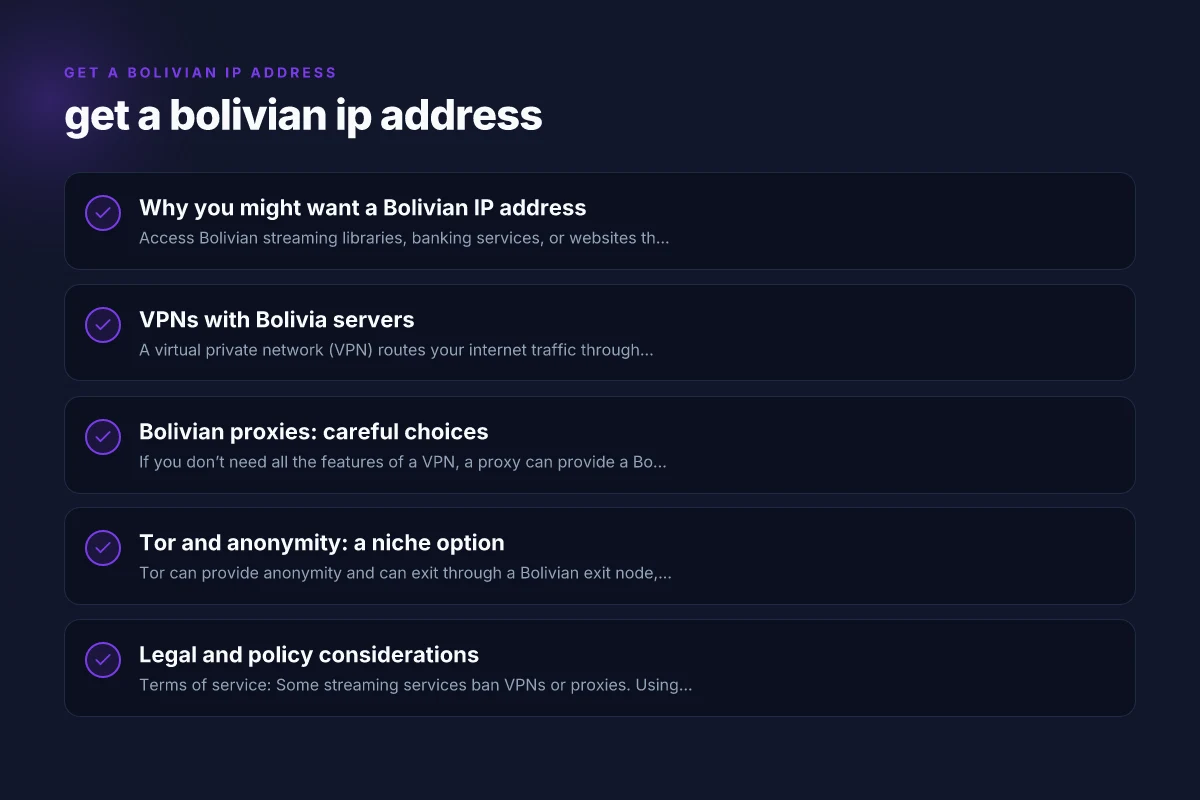
Why you might want a Bolivian IP address
- Access Bolivian streaming libraries, banking services, or websites that limit content to Bolivian users.
- Improve privacy by adding an extra geographic layer to your online footprint.
- Bypass geo-restrictions for travel or remote work where you need local access.
- Test apps or websites from a Bolivian network perspective.
Knowing your goal helps pick the right tool and setup. For most people, a VPN or a dedicated Bolivian proxy provides the best balance of speed, reliability, and security.
VPNs with Bolivia servers
A virtual private network (VPN) routes your internet traffic through a server in Bolivia, giving you a Bolivian IP address. This is the most common and user-friendly method.
How to choose a VPN
- Bolivia server presence: Confirm the provider has at least one Bolivian server.
- Privacy policy: Look for a clear no-logs policy and strong encryption (AES-256).
- Speed and reliability: Check reviews for steady connections and reasonable ping.
- Competitiveness: Compare price, simultaneous connections, and data caps.
- Jurisdiction: Prefer providers that align with your privacy expectations.
How to set it up
- Subscribe to a reputable VPN with Bolivian servers.
- Install the app on your device (Windows, macOS, iOS, Android, or browser extension).
- Open the app and log in.
- Choose a Bolivian server (city options may be listed. If not, any Bolivian server works).
- Connect and verify your new Bolivian IP by visiting a site like whatismyipaddress.com.
Pros and cons
- Pros: Easy, cross-device, reliable, good for streaming, strong privacy features.
- Cons: Some buffering for streams, some services may block VPN traffic, price adds up over time.
Bolivian proxies: careful choices
If you don’t need all the features of a VPN, a proxy can provide a Bolivian IP. Proxies can be cheaper but come with trade-offs.
When a proxy makes sense
- You only need a Bolivian IP for a specific app or browser.
- You’re testing location-based behavior for development without global traffic.
- You’re on a tight budget and can tolerate potential performance variability.
Types of proxies
- HTTP/HTTPS proxies: Easy to use for web traffic. Often single-application scope.
- SOCKS5 proxies: Broader support for apps and platforms. Typically better performance.
- Residential proxies: Use real devices in Bolivia. Higher reliability for some targets but pricey and potentially restricted.
How to use a Bolivian proxy
- Configure the proxy in the application or system settings with the given IP, port, and authentication.
- For browsers, many extensions let you specify the proxy and bypass system-wide settings.
- Test your connection by visiting a Bolivian IP checker or a geo-blocked site.
Pros and cons
- Pros: Low cost for some options, direct control, useful for testing.
- Cons: Less security than VPNs, some proxies are abuse-driven or unreliable, potential data leaks if misconfigured.
Tor and anonymity: a niche option
Tor can provide anonymity and can exit through a Bolivian exit node, potentially giving a Bolivian-visible IP. This approach is not guaranteed to produce a Bolivian exit, and performance can be slower. Get a belgian IP address
How Tor differs from VPNs
- Anonymity vs. access control: Tor focuses on anonymity; VPNs focus on location masking and privacy.
- Performance: Tor is usually slower due to multiple hops.
- Exit node variability: Bolivian exits may not always be available.
Practical use
- Use Tor for privacy-conscious browsing where a Bolivian IP is not critical, or when other options are blocked.
- If you need a Bolivian IP for streaming or consistent access, Tor is not the best choice.
Legal and policy considerations
- Terms of service: Some streaming services ban VPNs or proxies. Using these tools may violate terms and lead to account restrictions.
- Local laws: Bolivia has telecommunications and privacy laws. Ensure you understand the legal implications of masking your location.
- Data protection: VPNs and proxies can protect privacy but also require trust in the provider’s practices. Read privacy policies and data handling statements.
A quick compatibility table for choosing a method
| Method | Ease of use | Speed | Privacy | Reliability for streaming | Cost | Best for |
|---|---|---|---|---|---|---|
| VPN | High | High to medium | High | Good to excellent with compatible services | Moderate | General use, streaming, privacy |
| Bolivian Proxy | Medium | Medium to high | Medium | Variable; browsers/apps only | Low to moderate | Testing single apps, budgeting |
| Tor (Bolivia exit) | Low | Low to medium | High | Poor for streaming | Free (donations) | Anonymity, censorship circumvention |
| Residential proxy | Medium | High | Medium | Very good for targeted sites | High | Market research, access control tests |
How to test and verify your Bolivian IP
- Check your IP: Visit a site like whatismyipaddress.com to confirm the country shows Bolivia.
- Test stability: Open several pages or streaming apps to see if the IP remains stable over time.
- Geo-specific checks: If you’re testing a Bolivian service, try logging in and performing actions that require Bolivian location.
- Leak tests: Use browserleaks or dnsleak test tools to ensure your real IP and DNS aren’t leaking.
Security best practices when using location masking
- Use strong encryption: Prefer VPNs with AES-256 and secure protocols (OpenVPN, WireGuard).
- Enable kill switch: Prevents traffic leaks if the VPN drops.
- Verify DNS protection: Ensure the provider uses private DNS to avoid leakage.
- Be cautious with free tools: Free VPNs or proxies can monetize your data or inject ads.
- Update regularly: Keep apps and OS updated to minimize vulnerabilities.
Final recommendations
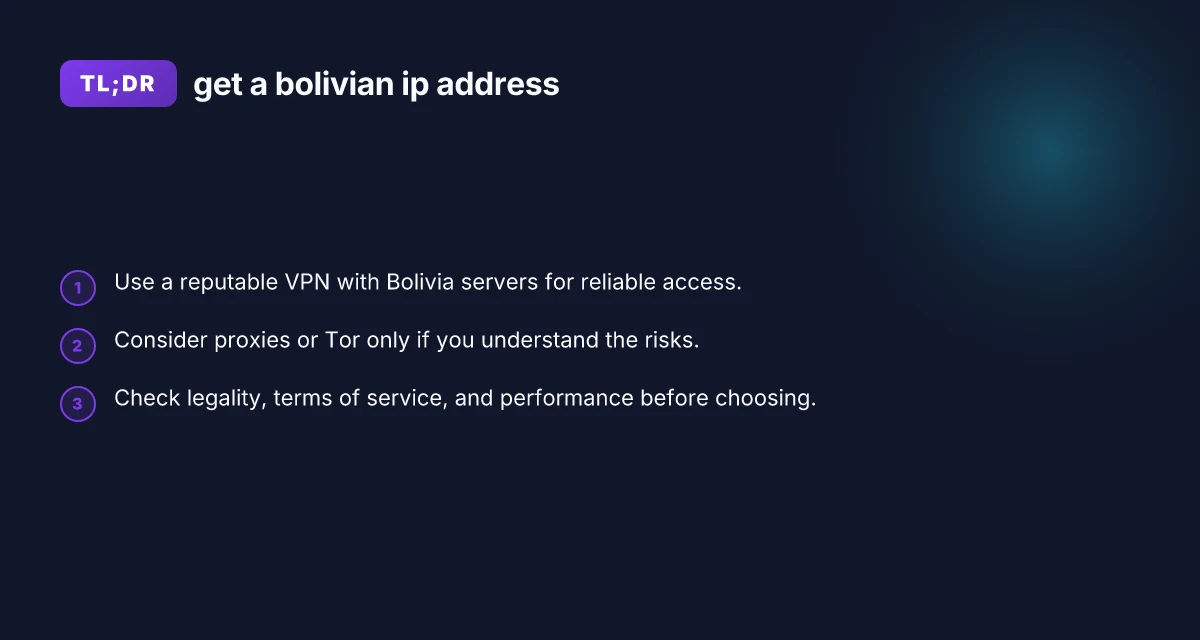
For most users who want a dependable Bolivian IP address for everyday browsing, streaming, or privacy, a reputable VPN with Bolivia servers is the best starting point. It offers reliable location masking, solid security features, and cross-device support. If you’re testing a single app or need occasional access, a Bolivian proxy can be a cost-efficient alternative, provided you’re aware of its limitations. If your priority is maximum anonymity and you can tolerate slower speeds, Tor with awareness of its performance trade-offs is an option, though not ideal for streaming or consistent access.
When choosing an approach, balance speed, privacy, and cost with your specific goals. Always review the provider’s privacy policy and terms of service, confirm Bolivian server availability, and test thoroughly before relying on the solution for critical tasks. If you’d like, tell me your exact use case (streaming, banking, testing, privacy) and the devices you plan to use, and I’ll tailor a setup plan with concrete steps and product recommendations.