Get a chinese IP address in ireland

Learn practical ways to obtain a Chinese IP address from Ireland, including legality, methods, and performance tips.
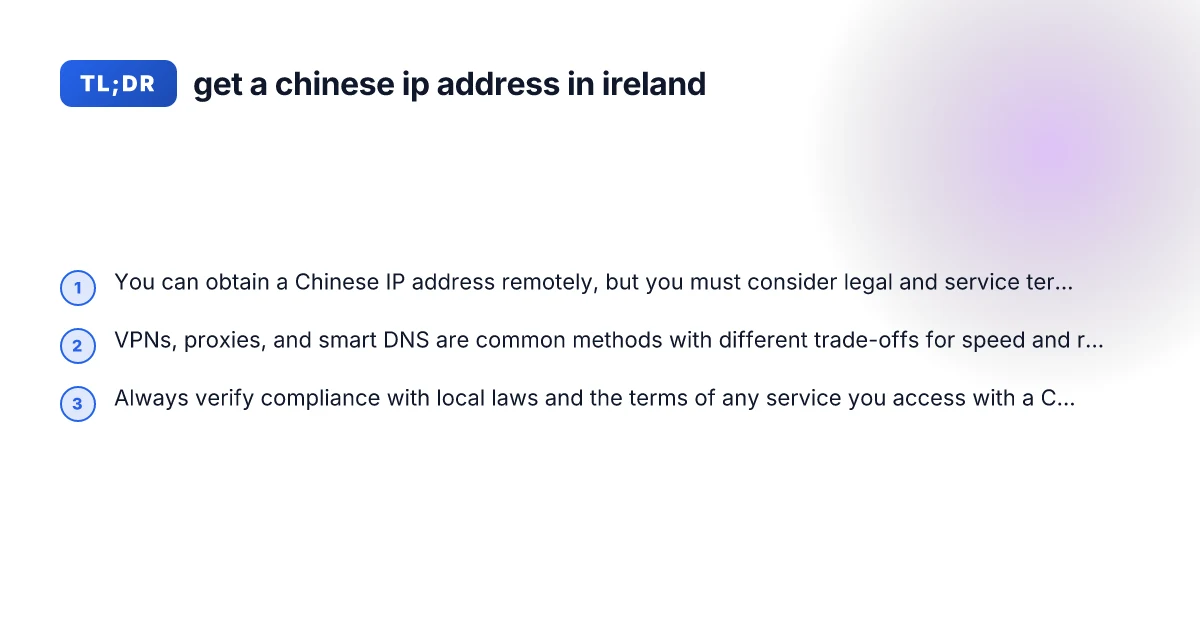
Getting a Chinese IP address while you’re physically located in Ireland is a common need for accessing region-restricted services, testing geolocation behavior, or researching content from China. This article explains the practical options, legal considerations, and how to choose the right method for your goals. Each approach has its own strengths and trade-offs in terms of legality, speed, reliability, and ease of use.

Why you might want a Chinese IP address from Ireland
- Accessing region-locked streaming or websites that require a Chinese IP.
- Testing websites or apps as they would appear to users in China.
- Conducting market research with China-based networks.
- Ensuring compliance or content licensing requirements for China-facing services.
Be aware that some services actively block or restrict access from VPNs, proxies, or known data-center IP ranges. Also, ensure you’re not violating terms of service, licensing agreements, or local laws when attempting to obtain a Chinese IP address.
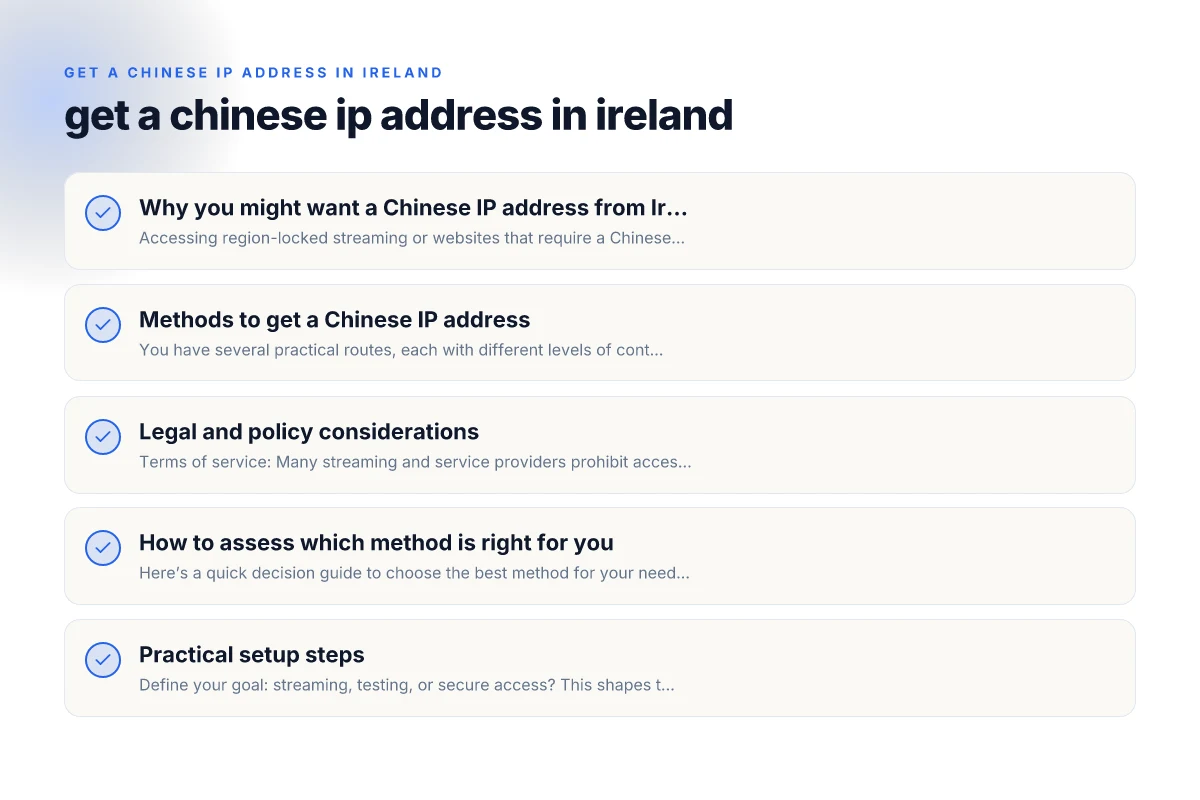
Methods to get a Chinese IP address
You have several practical routes, each with different levels of control, cost, and risk. Here are the main options, from most reliable for geo-targeting to the simplest.
VPN (Virtual Private Network)
- Pros:
- Easy to set up on many devices
- Good balance of speed and reliability
- Wide selection of servers in China or with exit nodes near China
- Cons:
- Some Chinese services block known VPN endpoints
- Performance can degrade due to distance and network policies
- How it works:
- You connect to a VPN server located in China (or near China for certain services that don’t require exact geolocation) and your traffic appears to originate from that location.
- Tips:
- Look for VPN providers offering dedicated Chinese servers or “China gateway” options.
- Test on the exact service you intend to use to confirm access.
- Check for obfuscated servers to bypass VPN blockers when necessary.
Proxy service
- Pros:
- Often cheaper than premium VPNs
- Simple browser-based usage for specific tasks
- Cons:
- Lower security. Traffic may be visible to the proxy provider
- Not reliable for all apps or streaming services
- How it works:
- Traffic is routed through a proxy server in China, making the destination see traffic as from China.
- Tips:
- Use HTTPS/SSL proxies for better security.
- Prefer SOCKS5 proxies for broader application support.
- Be cautious with free proxies. They can be slow or unsafe.
Smart DNS / DNS tunneling
- Pros:
- Fast because it doesn’t route all traffic through another country
- Works well for streaming via geo-unlocking
- Cons:
- Doesn’t change your actual IP address. Some services detect DNS tricks
- Not suitable for all apps or secure access needs
- How it works:
- DNS responses are manipulated to make certain services think you’re in China, while your IP remains your Irish address.
- Tips:
- Best for streaming or basic geo-unlock, not for secure access or login-protected services.
- Choose a reputable Smart DNS provider with China routing support.
Residential proxy networks
- Pros:
- Higher legitimacy and lower risk of IP blocks compared to data-center proxies
- Cons:
- More expensive
- Potential privacy concerns depending on provider policy
- How it works:
- Traffic is routed through real residential IPs located in or associated with China.
- Tips:
- Verify provider policies on logging and use terms.
- Confirm supported protocols and speed suitable for your tasks.
Dedicated server in China (self-hosted)
- Pros:
- Full control over hardware and software
- Stable, predictable performance if you manage it well
- Cons:
- Complex setup. Requires VPN or SSH tunneling
- Compliance and licensing considerations in China
- How it works:
- You rent or own a server in China and route traffic through it to simulate a Chinese IP locally.
- Tips:
- This option is usually overkill for casual access. Reserve for advanced needs or testing.
Legal and policy considerations
- Terms of service: Many streaming and service providers prohibit access via VPNs, proxies, or geolocation spoofing. Violating terms can lead to account suspensions or bans.
- Local laws: Regulations around circumvention tools vary by jurisdiction. In some cases, using VPNs or proxies may be restricted or regulated.
- Data privacy: When using third-party services, consider what data is logged, how it’s used, and where it’s stored.
- Compliance: If you’re performing business activities, ensure your approach aligns with licensing and regulatory requirements for China-based content.
How to assess which method is right for you
Here’s a quick decision guide to choose the best method for your needs. The table compares VPN, proxy, Smart DNS, and residential/proxy networks on key attributes.
| Method | IP change visible | Speed impact | Reliability for streaming | Security/Privacy | Ease of use | Cost (typical) |
|---|---|---|---|---|---|---|
| VPN | Yes (Chinese IP) | Moderate | High risk of blocks | Moderate to high | High | Medium-High |
| Proxy | Yes (Chinese IP) | Variable | Moderate to low | Low to moderate | Medium | Low-Medium |
| Smart DNS | No real IP, access proxyed | Low | High (for unlock) | Low to moderate | High | Medium |
| Residential network | Yes (Chinese IP via real devices) | Moderate to high | High if not blocked | Moderate to good | Medium | High |
Notes: Get a chinese IP address in greece
- “Speed impact” reflects typical overhead from routing, encryption, or DNS resolution.
- “Reliability” depends on provider infrastructure and how aggressively target services block the method.
Practical setup steps
- Define your goal: streaming, testing, or secure access? This shapes the choice.
- Pick a provider or setup route that matches your needs and budget.
- Prepare your devices: many services support VPN apps, browser extensions for proxies, or system-wide DNS settings for Smart DNS.
- Test with the exact service or site you plan to use, not just general connectivity.
- Validate IP location: use a simple IP checker to confirm the exit location appears as China.
Example setup paths:
- VPN path:
- Subscribe to a reputable VPN with China-based servers or China-gateway nodes.
- Install the app on your device, log in, connect to a Chinese server.
- Open the target service and verify geolocation behaves as expected.
- Smart DNS path:
- Subscribe to a Smart DNS service with China targeting.
- Configure DNS settings on your router or device as instructed.
- Test access to geolocked content. If needed, clear cache or re-authenticate.
- Proxy path:
- Acquire a China-based proxy (SOCKS5 or HTTP/HTTPS).
- Configure your browser or application to route traffic through the proxy.
- Confirm that the IP appears to originate from China and test the service behavior.
Performance expectations and troubleshooting
- Latency: Expect higher latency when routing through international routes. A VPN with optimized China gateways can offer reasonable speeds, but streaming and high-bandwidth tasks may suffer.
- Blocks: Some services aggressively block known VPN/Proxy exit nodes. If access fails, try a different server, switch to a residential proxy, or test Smart DNS for unblock purposes.
- Stability: Free or low-cost services tend to be less stable. If you rely on consistent access, consider paid plans with service level guarantees.
- DNS leaks: Especially with VPNs, ensure that DNS requests aren’t leaking outside the tunnel, which can reveal your true location. Use DNS leak tests and enable DNS leak protection if available.
- Device compatibility: Some smart TVs, gaming consoles, or routers may require manual VPN or DNS configuration. Check device support and documentation.
Safety and best practices
- Use trusted providers: Research reputable services with transparent privacy policies and independent reviews.
- Limit exposure: Only route traffic for the apps that need the Chinese IP when possible, especially with VPNs and proxies that affect all device traffic.
- Keep software up to date: Regularly update VPN apps, proxies, and router firmware to patch security vulnerabilities.
- Respect terms and licenses: Ensure your use aligns with the terms of service for both the provider and the content you access.
Final recommendations
If your goal is to reliably access content or conduct tests that require a Chinese IP address from Ireland, a paid VPN with specifically supported Chinese endpoints or a reputable residential proxy service is usually the best balance of reliability, speed, and ease of use. Smart DNS can be an attractive option for streaming unlocks with minimal speed loss, but it won’t provide a real IP and may not work for login-protected services or sites that verify user authentication beyond geolocation.
Before you commit, validate your exact use case:
- For streaming unlocks and general geo-access testing: Smart DNS or VPN with China gateways are strong contenders.
- For secure access and login-protected services: Prefer a VPN with robust encryption and server choices, or a residential proxy setup if you need more legitimacy and lower risk of blocks.
- For cost-conscious experiments: You might start with a reputable free trial of a VPN or a low-cost proxy, but be prepared to upgrade if performance suffers.
In short, yes, you can get a Chinese IP address in Ireland using VPNs, proxies, Smart DNS, or residential networks. The best choice depends on your priority: simplicity and streaming speed (Smart DNS or VPN), or higher legitimacy and reliability for complex access (residential proxies or self-hosted solutions). Always weigh legal considerations and service terms, and test with the exact service you intend to use to ensure the approach meets your needs. Get a chinese IP address in Germany