Get an IP address from the french southern territories
A practical guide to obtaining an IP address associated with the French Southern Territories, including practical steps and caveats.
Get an IP address from the French Southern Territories
If you’re asking how to get an IP address that appears to originate from the French Southern Territories (FT), you’re touching on a niche area of IP geography. The French Southern Territories include several scattered islands in the southern Indian Ocean, and the actual allocation of IP space to these territories is handled by global Internet registries and large network providers. In practice, most people don’t receive a unique, stand-alone IP block specifically assigned to theFT. Instead, they achieve the appearance of an FT IP via routing, VPNs, or proxy services that present an IP belonging to a provider with infrastructure in or near those territories. This guide walks you through options, limitations, and best practices to get as close as possible to an FT IP.
How IP addresses are allocated and what “FT IP” means
The reality of IP geography
- IP addresses are allocated in large blocks by regional internet registries (RIRs) like RIPE, ARIN, APNIC, etc.
- The French Southern Territories do not maintain a distinctive, frequently reissued, small block dedicated solely to them.
- Your visible IP is more about the provider’s network presence and geo-mapping than a strictly bound national designation.
Why this matters for you
- Applications that require geolocation accuracy (e.g., content access, testing, or compliance) may flag FT as a location if the IP is owned by an FT-connected provider.
- Misrepresenting location can conflict with terms of service or legal policies if you knowingly fake a location.
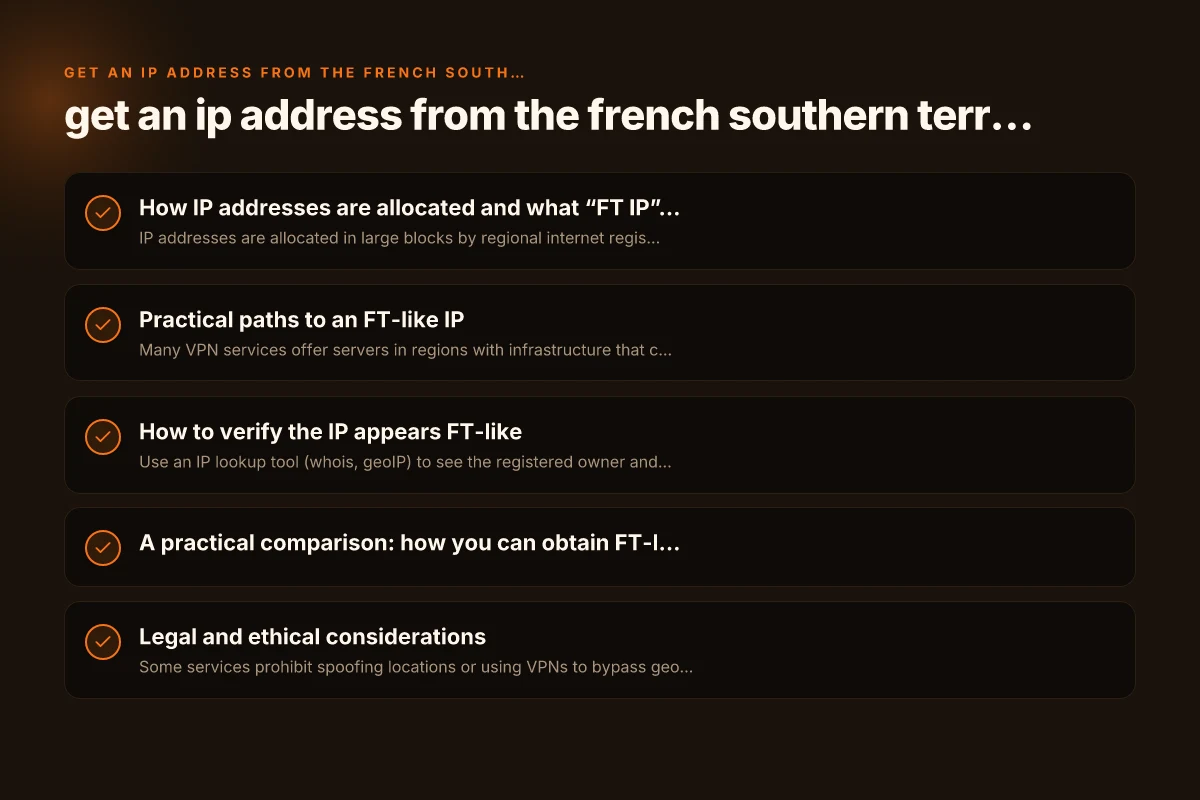
Practical paths to an FT-like IP
VPNs, proxies, and exit nodes
- Many VPN services offer servers in regions with infrastructure that can route traffic through providers with long-haul satellite or undersea links to the FT.
- If you need an IP that appears to be from FT, choose a VPN with a broad network footprint and explicitly offer routing through relevant ISPs or regions.
- Proxies can also provide a similar effect but may be less secure for sensitive tasks.
Dedicated and managed services
- Some specialized providers offer IPs from unusual or constrained geographies as part of a managed service or enterprise contract.
- These services often come with strict terms, SLAs, and higher costs.
Public cloud and Edge networks
- Some cloud providers announce IP ranges that route through data centers in or near territories connected to FT infrastructure.
- This path can yield IPs that, while not officially FT-designated, appear to originate from FT-visible networks.
How to verify the IP appears FT-like
Check localization and ownership
- Use an IP lookup tool (whois, geoIP) to see the registered owner and country/region metadata.
- The owner might be a global telecom/provider with a presence in multiple countries rather than FT itself.
Verify routing and latency
- Ping and traceroute the IP to see the geographic hop patterns. Longer routes may indicate non-localized exits.
- Consider using multiple checks over time to account for dynamic routing.
Content access and compliance tests
- Some services rely on accurate geolocation. Test whether FT-specific measures (like country-based access) behave as expected with your IP.
- Be aware that many sites use multiple signals (GPS, browser locale, DNS) beyond IP to determine location.
A practical comparison: how you can obtain FT-like IPs
| Method | Typical control | Pros | Cons | Best for |
|---|---|---|---|---|
| VPN with FT-region exit | Moderate | Easy, low cost, flexible | IP may rotate; not guaranteed FT appearance | Casual testing, regional access tests |
| Dedicated/managed service | High | Strong guarantees, SLA, stable IP | Higher cost; complex setup | Enterprise needs, compliance testing |
| Public cloud edge routing | Moderate | Scalable, potential FT routing | Less predictability; complex billing | Large-scale testing, throughput needs |
| Proxies in FT-connected networks | Low-Moderate | Simple to implement | Privacy concerns; trust issues | Quick FT-like location for demos |
Legal and ethical considerations
Geolocation and terms of service
- Some services prohibit spoofing locations or using VPNs to bypass geo-restrictions.
- Always review terms of service for the application you’re using to avoid violations.
Data privacy and security
- VPNs and proxies introduce trust considerations: you route your traffic through a third party.
- Choose reputable providers with transparent privacy policies and strong encryption.
Compliance and export controls
- In some industries, presenting a location for regulatory or export control purposes may require documentation or specific certifications.
- If in doubt, consult legal counsel or compliance teams within your organization.
Technical steps to attempt obtaining an FT-like IP via a VPN
- Identify a reputable VPN provider with a broad international network and a track record for stable exit points.
- Look for servers that advertise presence in or near regions historically connected to FT infrastructure or with routes through FT-adjacent networks.
- Connect to the chosen server and test your visible IP:
- Use an IP lookup service to confirm the country or region appears to be FT-relevant.
- Run latency tests to see if the route matches expected undersea cable paths or satellite links.
- Validate application behavior:
- Access region-restricted content or perform geolocation-dependent tests to ensure the IP behaves as intended.
- Monitor for IP changes:
- Some providers rotate IPs. If stability is crucial, select a service with fixed endpoints or enterprise plans.
If you require a stronger guarantee of FT attribution, you’ll likely need a bespoke solution from a provider that can advertise specific ASNs and IP blocks tied to FT infrastructure or a contract with a telecom operator that has a direct FT footprint. This path is usually reserved for businesses with explicit regional requirements and compliance needs.
Understanding limitations: why a perfect FT IP is unusual
- The French Southern Territories cover a small geographic footprint with limited population and infrastructure, diminishing demand for FT-specific IP blocks.
- Global routing policies prioritize efficiency and redundancy; FT’s island geography makes isolated blocks less common for public allocation.
- Many IPs that appear to be FT-originated are the result of provider hops, not contained and managed from FT’s own address blocks.
Final section: recommendations
- If your goal is just to test geolocation behavior or access region-specific resources, a reputable VPN with a thoughtfully chosen exit can achieve FT-like results without heavy commitments.
- For formal or regulatory tasks requiring verifiable FT attribution, consider working with a professional IT services provider or telecom partner to discuss a dedicated solution with explicit routing and documentation.
- Always verify IP visibility with multiple tools and over time, since routing can change and affect your apparent location.
- Be transparent about location in any legitimate contexts. If you need to demonstrate a true FT presence for a business reason, document your approach and ensure compliance with all applicable terms and laws.
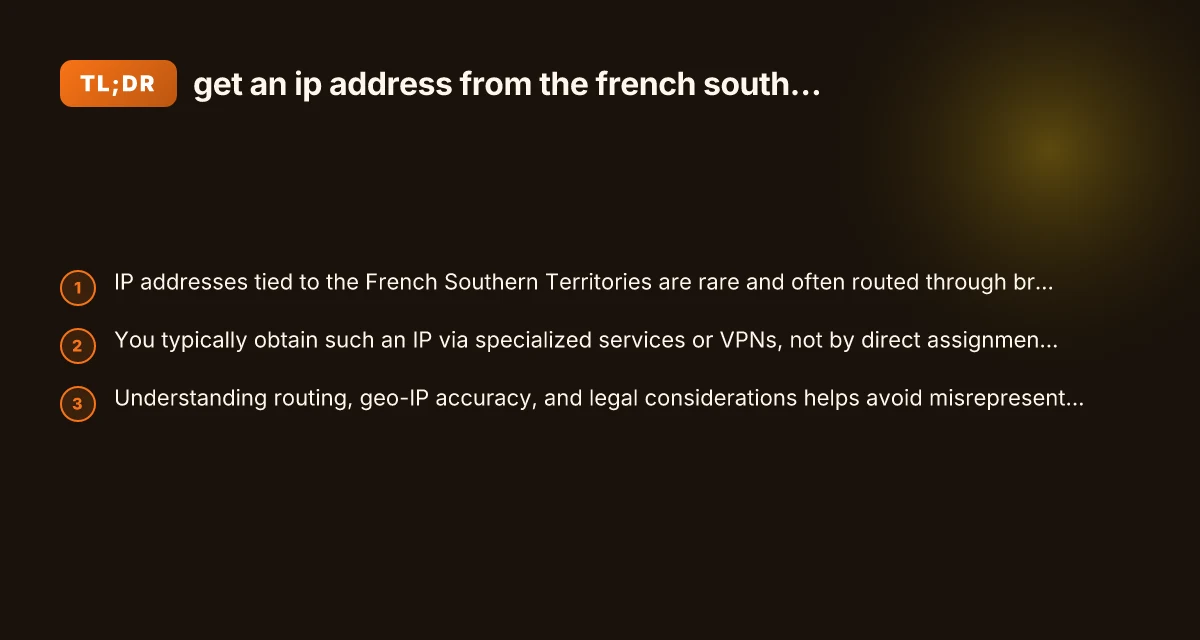
In short, getting an exact, independently verifiable IP block assigned to the French Southern Territories is uncommon for most users. Practical options involve VPNs, proxies, and managed services that offer FT-like appearances. With careful choice of provider and clear compliance considerations, you can achieve the FT appearance for testing, development, or regional access needs while staying within legal and ethical boundaries.