Get an IP address from malta
A practical guide to obtaining and using an IP address from Malta, including options, considerations, and tips.
Getting an IP address from Malta means making your online presence appear as if you’re browsing from Malta. This can be useful for accessing Malta-only services, testing regional availability, or complying with local content rules. There are several practical routes to obtain a Malta IP address, each with its own trade-offs in terms of speed, cost, and legality. Below you’ll find a clear overview of how to get a Malta IP address, when to choose each method, and practical tips to stay safe and compliant.

Methods to obtain a Malta IP address
There are three common approaches: VPNs, proxies, and Malta-based hosting or leased servers. Each method has its own benefits and limitations. Here’s how they typically work:
VPN (Virtual Private Network)
- Encrypts your traffic and routes it through a remote server located in Malta.
- Your IP address appears as the Maltese server’s IP.
- Benefits: Easy to use, good privacy, broad device support.
- Limitations: Some services block VPNs, speed depends on the VPN provider and server load, legal terms vary by provider.
Proxy services
- Acts as an intermediary for your web requests, often at the application level (e.g., HTTP/HTTPS, SOCKS).
- You can select a Malta IP for web browsing or specific apps.
- Benefits: Often cheaper or free options, simple to set up for specific tasks.
- Limitations: Usually less secure than VPNs, no end-to-end encryption, only traffic that passes through the proxy is affected.
Malta-based hosting or virtual private servers (VPS)
- Rent a server physically located in Malta or via a Malta-based data center.
- You control the server’s IP and can use it as a gateway, VPN endpoint, or for hosting services that require a Maltese IP.
- Benefits: Full control, predictable performance, suitable for professional use and testing.
- Limitations: Higher cost, technical setup required, compliance and bandwidth considerations.
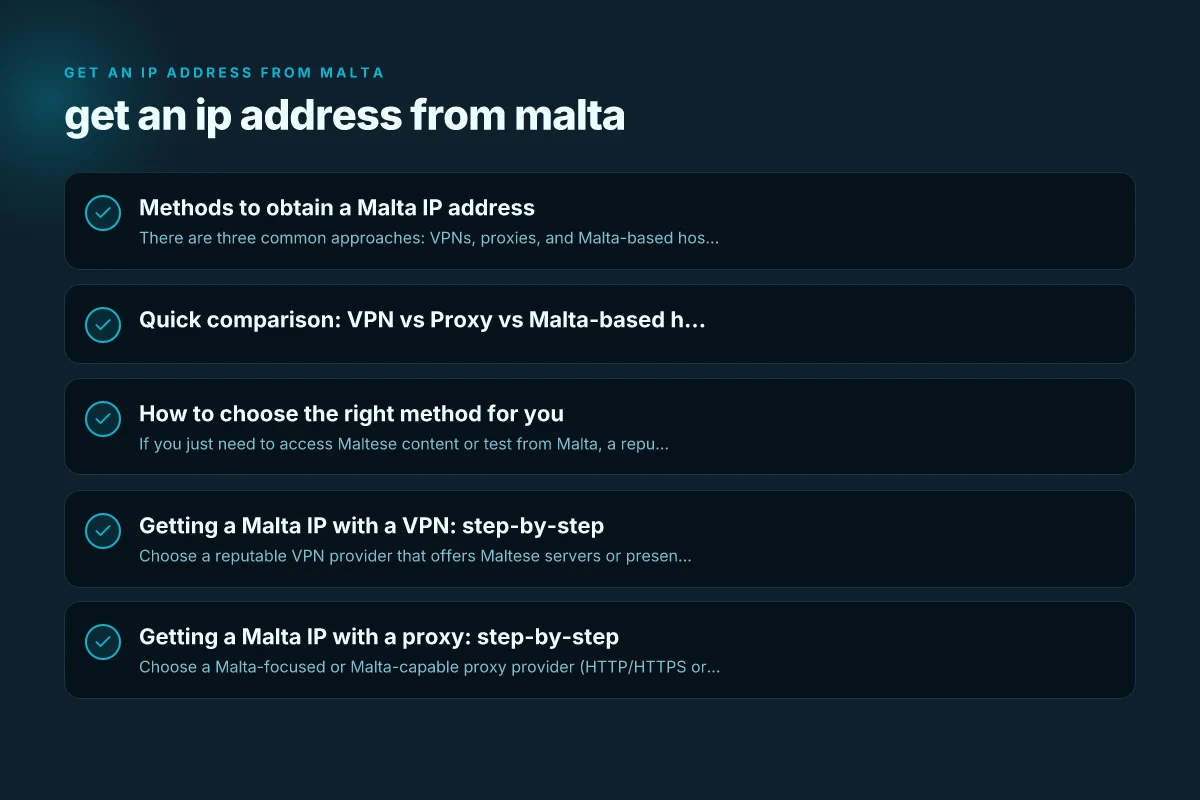
Quick comparison: VPN vs Proxy vs Malta-based hosting
| Method | Typical Use Case | Pros | Cons |
|---|---|---|---|
| VPN | General browsing, streaming from Malta | Easy setup, strong encryption, broad app support | Possible speed loss, VPN blocks, shared IP risk |
| Proxy | Task-specific browsing, lightweight access | Cheap or free options, simple for single apps | No encryption, potential leaks, limited to configured apps |
| Malta-based hosting/VPS | Professional testing,-hosting Malta-restricted apps | Full control, reliable performance, direct Maltese IP | Higher cost, technical setup, ongoing maintenance |
How to choose the right method for you
- If you just need to access Maltese content or test from Malta, a reputable VPN with Malta servers is the simplest path.
- If you need to run a single application through a Maltese IP without encrypting all device traffic, a proxy can be a quick solution.
- If you require a stable Maltese presence for business, testing, or hosting, consider renting a Malta-based VPS or dedicated server to obtain a fixed Maltese IP and full control.
- Always check the provider’s terms of service, data handling policies, and any geographic restrictions on content or services you plan to access.
Getting a Malta IP with a VPN: step-by-step
- Choose a reputable VPN provider that offers Maltese servers or presence in Europe with Maltese IPs.
- Create an account and install the VPN app on your device(s) (Windows, macOS, iOS, Android, Linux, and sometimes browser extensions).
- Open the app, log in, and select a server located in Malta.
- Connect and verify your IP address. You can use a site like whatismyipaddress.com to confirm the Maltese IP.
- Test the service you intend to access to ensure it works with the Maltese IP and that you’re satisfied with speed and reliability.
Getting a Malta IP with a proxy: step-by-step
- Choose a Malta-focused or Malta-capable proxy provider (HTTP/HTTPS or SOCKS).
- Obtain the proxy address, port, and any authentication details.
- Configure your browser or application to use the proxy:
- In browsers, set the proxy under the network or connection settings.
- For applications, enter the proxy details in the respective app’s network or proxy settings.
- Visit a site to confirm your IP appears as Maltese.
- Be mindful of the security limitations. Avoid transmitting sensitive data through unencrypted proxies.
Malta-based hosting or VPS: step-by-step
- Look for hosting providers with data centers in Malta or with explicit Maltese IP allocations.
- Choose a plan that fits your needs (CPU, RAM, bandwidth) and budget.
- Set up your server and obtain the Maltese IP address. This usually involves configuring network interfaces or requesting a specific IP.
- Install your preferred software (VPN server, web server, or remote access tool) as needed.
- If you need outbound Maltese IP for specific apps, configure firewall rules and NAT accordingly.
- Use SSH or a remote desktop connection to manage the server, ensuring security best practices.
Compliance, legality, and best practices
- Respect local laws: Ensure your use of a Maltese IP complies with local regulations and the terms of service of sites and services you access.
- Privacy considerations: VPNs and Malta-based services can log activity. Read the privacy policy and understand data retention practices.
- Security basics: Use strong authentication, keep software up to date, and enable encryption where possible.
- Data protection: If handling personal data, ensure you have appropriate data protection measures and, if necessary, comply with GDPR standards.
- Avoid misuse: Do not use Maltese IPs to commit fraud, commit illegal activities, or violate service agreements.
Common use cases for a Malta IP address
- Accessing Malta-only streaming libraries or regional content while traveling.
- Testing websites or apps for Maltese users or content localization.
- Conducting market research or QA from a Maltese network perspective.
- Running a Malta-based service, API, or staging environment for local customers.
Practical tips for reliability and performance
- Choose providers with low-latency Malta routes and good uptime guarantees.
- If speed matters, prioritize VPN options with optimized Maltese server networks and reputable hardware.
- For sensitive work, prefer VPNs with a kill switch and leak protection to prevent IP leakage.
- If you’re using proxies, choose trusted providers that offer over TLS/SSL encryption and transparent logging policies.
- Regularly verify your Maltese IP through trusted sites to ensure you’re still routed through Malta as intended.
Final recommendation
For most casual or mixed-use scenarios, starting with a reputable Malta-capable VPN is the best balance of ease, privacy, and reliability. It lets you quickly switch to a Maltese IP, protects your data with encryption, and works across multiple devices. If you require a persistent, fixed Maltese IP for professional testing, hosting, or services with strict IP requirements, a Malta-based VPS or dedicated server provides the most control and stability, though at a higher cost and setup complexity. Always verify the provider’s terms and ensure your usage aligns with local laws and service terms.