Get an IP address from haiti
Practical ways to obtain or simulate an IP address from Haiti for online access, testing, or privacy.
Getting an IP address from Haiti can be useful for geolocation testing, accessing region-restricted content, or protecting your privacy. There isn’t a single “official Haitian IP” you can grab like a download link. Instead, you use tools and services that route your traffic through Haitian exit nodes. Below is a practical guide covering options, what to expect, and how to choose the right approach for your needs.
Why you might want a Haitian IP address
- Geolocation testing: Web developers and marketers test how sites behave for users in Haiti.
- Content access: Some services or tools restrict content by country.
- Privacy and security: Masking your true location can add a layer of privacy.
- Compliance considerations: Some business use cases require careful handling of data residency or access controls.
By understanding your goal, you can pick a method that balances speed, cost, and legality.
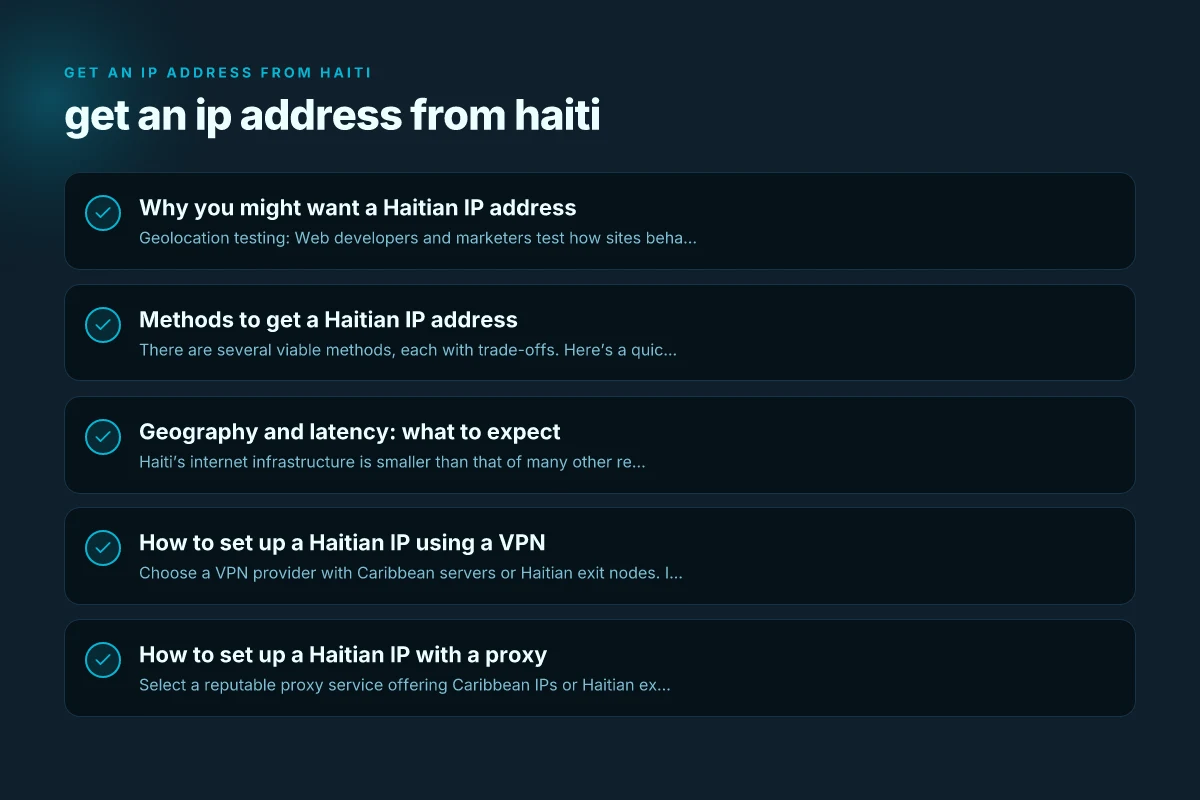
Methods to get a Haitian IP address
There are several viable methods, each with trade-offs. Here’s a quick overview:
VPNs with Haitian servers
- Pros: Easy to use, good encryption, reliable for streaming and browsing.
- Cons: Some services may block known VPN IPs. Speeds depend on server load.
- What to look for: A VPN provider with Haitian or nearby Caribbean servers, strong encryption (AES-256), no-logs policy, and transparent jurisdiction.
Proxies (HTTP/HTTPS or SOCKS)
- Pros: Often cheaper than VPNs, can be configured per application.
- Cons: Proxies typically don’t encrypt traffic. Higher risk of leakage if misconfigured.
- What to look for: Reputable proxy providers offering Haitian exit nodes or Caribbean-based IPs, plus authentication to prevent abuses.
Dedicated or shared IPs from providers
- Pros: Consistent IP address or set of addresses, easier management for business use.
- Cons: Can be more expensive. May require staff to manage firewall rules.
- What to look for: Providers offering Caribbean geolocations or Haitian IP ranges, SLA-backed uptime, and easy integration with your network.
Tunneling and remote desktop scenarios
- Pros: You control a Haitian-based host, ensuring predictable latency.
- Cons: More complex setup. Requires a server or VM in Haiti or nearby.
- What to look for: Cloud providers with data centers in the region or second-best proximity, secure SSH/VPN access, and clear usage policies.
Tor plus exit nodes
- Pros: Strong anonymity and low cost.
- Cons: Significantly slower. Not ideal for streaming or interactive tasks.
- What to look for: Tor configuration aimed at exit nodes in the Caribbean region when possible, plus understanding of latency effects.
Geography and latency: what to expect
- Haiti’s internet infrastructure is smaller than that of many other regions, so latency can be higher to distant locations.
- If you’re testing a service’s performance for Haitian users, aim for an exit point in or near the Caribbean to reduce latency.
- Proximity matters: the closer the exit node to your target audience, the better the response times.
How to set up a Haitian IP using a VPN
- Choose a VPN provider with Caribbean servers or Haitian exit nodes. If none are available, pick a nearby country (Dominican Republic, Jamaica) and test whether the service maps to Haitian IPs.
- Install the VPN app on your device and log in.
- Connect to a Haitian server or the closest available Caribbean server.
- Verify your IP and location: visit a site like whatismyipaddress.com to confirm the country code and city if shown.
- Optional: enable features like kill switch and DNS leak protection to preserve the Haitian IP during use.
How to set up a Haitian IP with a proxy
- Select a reputable proxy service offering Caribbean IPs or Haitian exit nodes.
- Configure your browser or individual apps to use the proxy server (IP, port, and credentials if required).
- Test your connection by visiting an IP check site to confirm the location.
Table: VPN vs Proxy for Haitian IP needs
| Feature | VPN (Haiti or Caribbean server) | Proxy (Caribbean/Haiti exit) |
|---|---|---|
| Encryption | Yes (AES-256 or better) | Typically no (unless using HTTPS proxy) |
| Anonymity/Privacy | High (tunnels all traffic) | Moderate (depends on proxy type) |
| Ease of use | High | Medium to high |
| Performance impact | Moderate to noticeable | Often lighter, but depends on proxy load |
| Cost | Subscription-based | Pay-per-use or subscription |
| Application scope | System-wide or per app | Per-application or per browser |
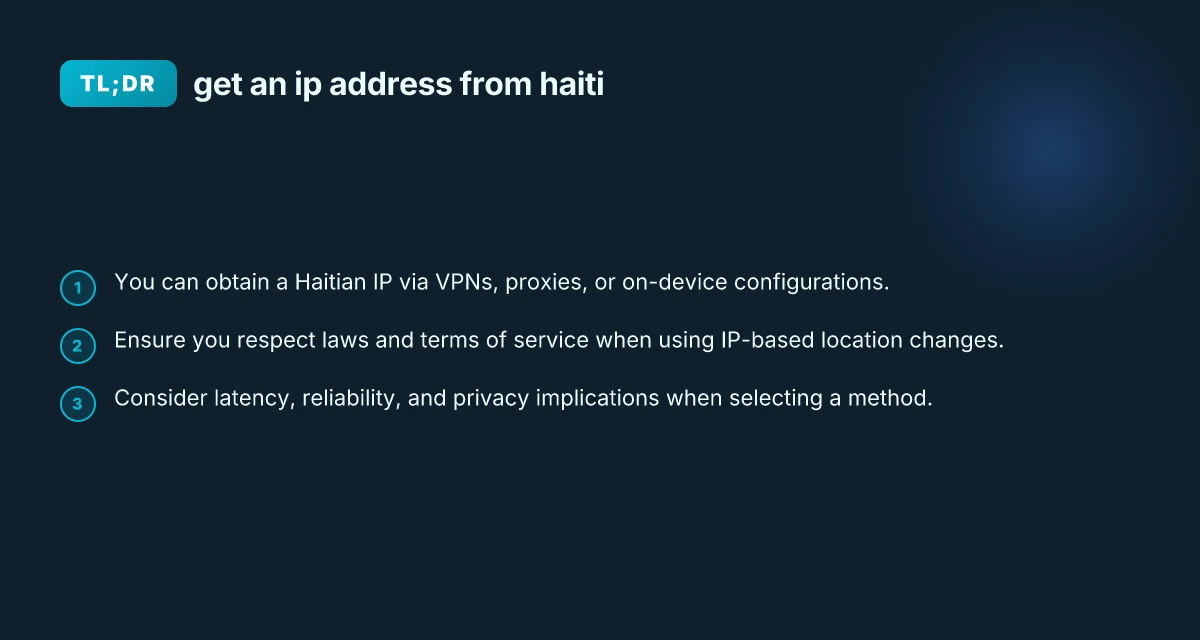
Best practices for legality and safety
- Check terms of service: Some sites prohibit spoofing location or using VPNs to bypass geo-restrictions.
- Respect data privacy laws: Ensure you’re compliant with local and international regulations in your usage.
- Avoid abuse: Do not engage in fraudulent activities, spamming, or wrongdoing through a Haitian IP.
- Secure your connection: Use strong encryption, enable a kill switch, and keep software updated.
- Use reputable providers: Research reviews, transparency reports, and independent audits when possible.
Troubleshooting common issues
- No Haitian IP visible: The exit node might be off or blocked. Try a different Caribbean server or contact support.
- Slow speeds: Check server load, switch to a nearby country, or test during off-peak hours.
- DNS leaks: Enable DNS leak protection in your VPN or configure DNS through the VPN tunnel.
- IP blocking by services: Some sites ban VPN IP ranges. Rotate servers or use a different method (proxy or dedicated IP) if allowed.
Quick-start checklist
- Define your use case (testing, access, privacy).
- Choose a method (VPN, proxy, dedicated IP) that fits your needs and budget.
- Pick a reputable provider with Caribbean/Haitian options or proximate locations.
- Set up and verify: connect, test the IP, and confirm the country code.
- Protect your privacy: enable security features, monitor for leaks, and review terms.
Final recommendation
If you need a reliable Haitian IP for general browsing or light testing, a reputable VPN with Caribbean servers is typically the simplest and most secure option. It shields your traffic, reduces the risk of leaks, and provides a straightforward setup. If you require more control over a single IP or have application-specific needs, consider a dedicated Haitian IP from a trusted provider, but weigh costs and compatibility with your use case. Always stay within legal boundaries and respect service terms. If your goal is just occasional geolocation testing, start with a VPN trial and evaluate latency, stability, and the accuracy of the location shown. Get an IP address from guernsey