Get an IP address from guatemala
Learn practical ways to obtain an IP address based in Guatemala for security, streaming, or testing needs.
Getting an IP address that appears to come from Guatemala can be useful for market research, geo-targeted testing, or accessing region-locked services. There are several legitimate ways to obtain a Guatemala-based IP, each with its own benefits, trade-offs, and legal considerations. Below is a practical guide to help you choose the right method for your needs and how to use it effectively and responsibly.
Why you might want a Guatemala IP
- Access region-restricted content or services that are only available in Guatemala
- Test websites, apps, or APIs from a Guatemalan IP to verify localized behavior
- Conduct competitive research or press monitoring with a Guatemala vantage point
- Enhance privacy by masking your real location when appropriate and legal
Geographic IPs are achieved by routing your traffic through Guatemalan networks or by using servers physically located in Guatemala. It’s important to understand that the “country of origin” of an IP address is determined by the IP’s allocation and the routing path, which means you’re not simply changing your country in a magic switch. You’re effectively sending traffic through equipment managed by a Guatemalan provider or a service with Guatemalan endpoints.
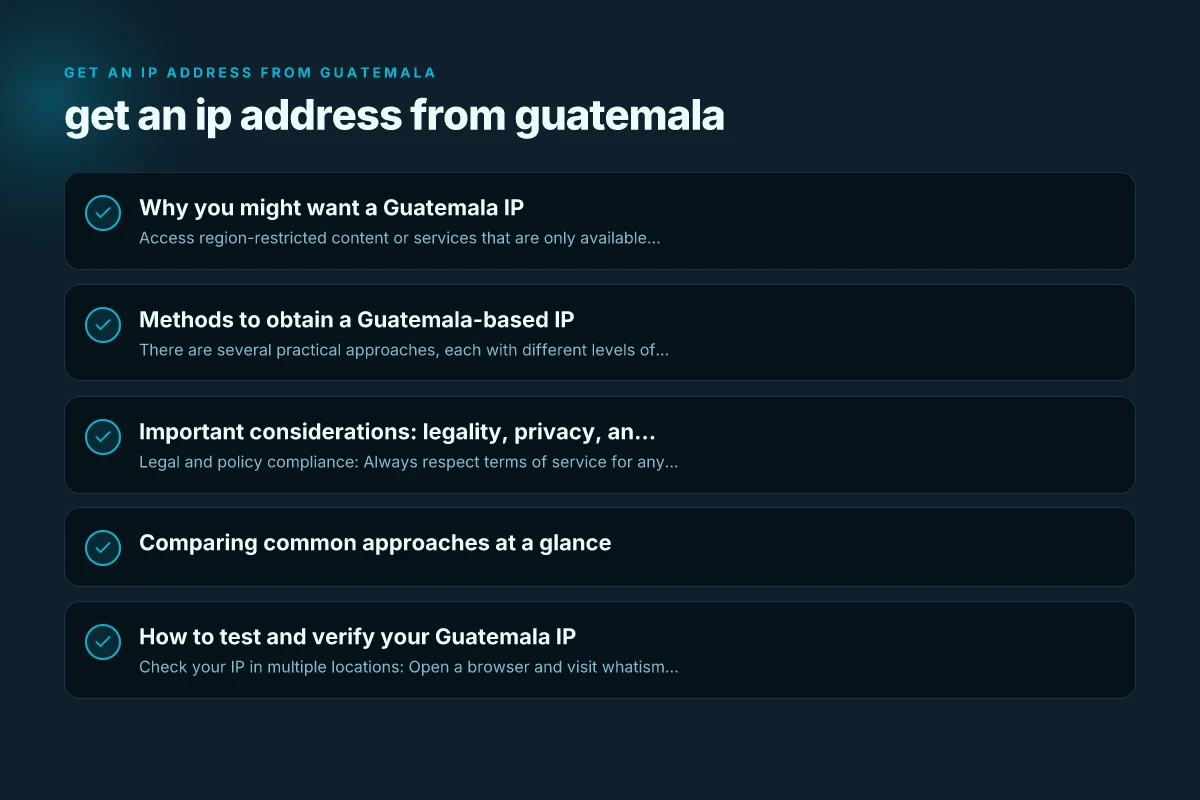
Methods to obtain a Guatemala-based IP
There are several practical approaches, each with different levels of control, cost, and risk.
1) Virtual Private Network (VPN) with Guatemala endpoints
- Pros:
- Simple to use
- Reliable performance with modern VPN networks
- Often includes kill switch and DNS leak protection
- Cons:
- Some services block VPN IPs
- Shared IPs can be affected by neighbors (blacklisting)
- How to choose:
- Verify they list Guatemala as an available country
- Check simultaneous connections and supported protocols (OpenVPN, WireGuard)
- Look for independent DNS leak tests and a documented privacy policy
2) Guatemala-based proxy services
- Pros:
- Flexible for web scraping or targeted streaming
- Often cheaper than full VPN for specific tasks
- Cons:
- Proxies can be slower or unreliable
- Less secure than a full VPN. Traffic may be visible to the proxy provider
- How to use:
- Choose HTTP/HTTPS or SOCKS proxies depending on your application
- Configure application or browser to route traffic through the proxy
- Rotate proxies if you need multiple Guatemalan IPs
3) Cloud or dedicated servers in Guatemala
- Pros:
- Full control over your environment
- Consistent performance and dedicated IPs
- Cons:
- Higher cost and more setup effort
- Requires server management skills
- How to adopt:
- Spin up a VM or bare-metal server in a Guatemalan data center (via providers that offer Guatemala locations)
- Establish a VPN or SSH tunnel to route your traffic through the Guatemala server
- Use the server’s IP as your Guatemala IP in clients
4) Remote desktop or SSH tunnels to a Guatemala-based host
- Pros:
- Simple for single-user access
- Can be combined with VPN or SOCKS proxy
- Cons:
- Not ideal for all traffic types. Performance depends on the host
- How to do:
- Set up an SSH dynamic port forwarding (SOCKS) on a Guatemala host
- Configure your device to use localhost:1080 (or the port you chosen) as a SOCKS proxy
- Route only the traffic you want through the tunnel
5) Mobile operators and SIM-based options
- Pros:
- Genuine Guatemalan IPs if the device uses a local SIM and the carrier’s network
- Cons:
- Typically not practical for long-running tasks
- Data costs and throughput can vary
- Use case:
- Quick checks or location-based testing from a mobile device in Guatemala
Important considerations: legality, privacy, and reliability
- Legal and policy compliance: Always respect terms of service for any content or service you access. Some platforms prohibit using VPNs or proxies to circumvent regional restrictions.
- Privacy and data protection: Understand how your data is handled by each provider. Read privacy policies and consider end-to-end encryption where possible.
- IP reputation and blocking: Some VPNs and proxies share IPs that may be flagged or blocked by services. If you encounter blocks, try different servers, providers, or rotate IPs.
- Latency and throughput: Guatemala is geographically distant for many users. Choosing a provider with optimized routes and sufficient bandwidth is essential for a smooth experience.
- Security: Use reputable providers with strong encryption, secure DNS, and a kill switch to prevent IP leaks.
Comparing common approaches at a glance
| Method | Pros | Cons | Typical Use Cases | Example providers (illustrative) |
|---|---|---|---|---|
| VPN with Guatemala endpoint | Easy, secure, multi-device support | IPs may be shared, some blocks | General access, testing, streaming | ExpressVPN, NordVPN, Surfshark (check Guatemala availability) |
| Guatemala proxies | Cheap, task-specific | Variable reliability, less secure | Web scraping, geo-targeted requests | Smartproxy, Bright Data, Local proxies (region-specific) |
| Guatemala cloud/dedicated server | Full control, reliable, scalable | Higher cost, setup needed | Stable workloads, API access | AWS with Guatemala region, DigitalOcean, Vultr (regional availability) |
| SSH/SOCKS tunnel | Lightweight, simple for single user | Limited to routed traffic, setup steps | Quick tests, development work | OpenSSH, local SOCKS proxy setup |
| Local SIM/mobile data | Genuine local IP for short tasks | Costly for long work, mobility needed | Quick checks from Guatemala | Local carriers in Guatemala |
How to test and verify your Guatemala IP
- Check your IP in multiple locations: Open a browser and visit whatismyipaddress.com or ipinfo.io to confirm the country shows Guatemala.
- Test DNS leaks: Use a tool like dnsleaktest.com to ensure DNS requests aren’t leaking your real location.
- Validate consistency: If you need a dedicated Guatemala IP, a cloud server or dedicated proxy is preferable to rotating VPN IPs.
- Check geolocation accuracy: Some services rely on ISP routing data. Test with a service you intend to access to confirm the IP geolocation behaves as expected.
- Consider speed tests: Run speed tests while connected to the Guatemala IP to ensure the method meets your needs.
Practical setup examples
- VPN setup (Guatemala endpoint):
- Subscribe to a VPN service with Guatemala servers
- Install the VPN app on your device
- Connect to a Guatemala server
- Verify IP location via a browser test page
- Guatemala proxy setup (web browser):
- Obtain a Guatemala proxy server address and port
- In your browser, set the proxy configuration (HTTP/HTTPS or SOCKS)
- Ensure authentication if required
- Browse to verify the IP shows Guatemala
- Cloud VM setup (Guatemala location):
- Create a VM in a provider’s Guatemala data center
- Install a VPN or configure SSH dynamic port forwarding
- Route traffic through the VM
- Confirm Guatemala IP via an IP check site
Final recommendations
If your primary goal is reliability and ongoing use, a reputable VPN with Guatemala endpoints is typically the easiest and safest starting point. It provides strong encryption, user-friendly apps, and broad compatibility across devices. If you need a long-term, stable Guatemala IP for specific tasks like automated testing or API calls, a dedicated Guatemala-based cloud server or a managed proxy with good geographic coverage may be more appropriate. Always prioritize providers with transparent privacy policies, robust security features, and clear terms of service.
If you want a concrete recommendation tailored to your exact use case (type of tasks, devices, budget, and acceptable trade-offs between speed and privacy), share more details and I can suggest a short list of options and a quick setup plan. Get an IP address from grenada