Get an IP address from brunei darussalam

A practical guide to obtaining an IP address from Brunei Darussalam, covering options, considerations, and best practices.
Getting an IP address from Brunei Darussalam isn’t as simple as just picking a country code. Brunei has a small internet footprint, and IP allocations are controlled by regional and national authorities. However, there are practical ways to obtain an IP address that appears to originate from Brunei Darussalam for testing, development, or compliance reasons. This article walks you through the options, their pros and cons, and how to implement them responsibly.

Why you might want an IP address from Brunei Darussalam
Feeding traffic through a BRU-located IP can be beneficial for:
- Compliance testing with Brunei’s regulatory requirements or local partner networks.
- Access to region-specific content that checks for geolocation proximity.
- Brand or business testing to verify how Brunei-based users experience your service.
- Developing or staging environments that mimic Brunei-based traffic without traveling there.
However, it’s important to note that geolocation is imperfect. Many services rely on IP-based heuristics, subnets, and sometimes VPN fingerprints. If accuracy is critical, you should combine IP geolocation with other signals (user-provided location, device data, etc.)
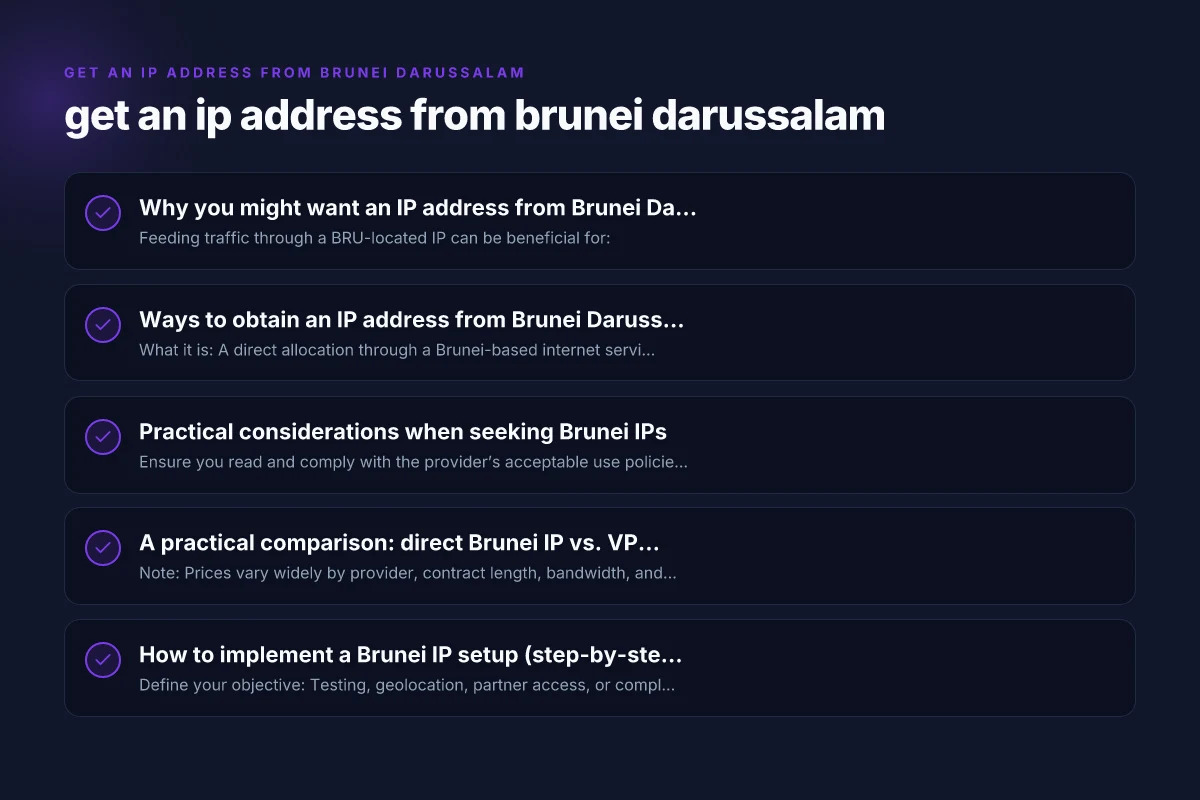
Ways to obtain an IP address from Brunei Darussalam
1) Use a Brunei-based ISP for direct allocation
- What it is: A direct allocation through a Brunei-based internet service provider. This usually means you have a dedicated or dynamic IP address that is part of their ASN and their IPv4/IPv6 pools.
- Pros:
- Generally lower latency to Brunei users.
- Greater legitimacy if you need to present as Brunei-originating traffic.
- Cons:
- Expensive for many use cases.
- Long approval times for business accounts.
- You must physically or logically terminate at their network, which can complicate multi-region setups.
- Best for: Enterprise testing, partner integrations, and scenarios requiring stable Brunei-origin IPs.
2) Use a VPN with a Brunei exit node or BRU-mapped IP
- What it is: A virtual private network service that provides an exit point in Brunei or a BRU-mapped IP. Some VPNs offer country-level exit options. You’ll route traffic through a Brunei-based endpoint.
- Pros:
- Lower upfront cost than a dedicated ISP lease.
- Flexible on-demand access. Easy to switch regions.
- Cons:
- Some services detect VPNs and block or throttle.
- Higher latency than direct ISP allocations for Brunei-based users.
- Potentially less stable if the VPN provider has overlapping or shared infrastructure.
- Best for: Testing geolocation, content access, and development environments where you need Brunei exposure without a long-term contract.
3) Use a cloud provider with a BRU region or BRU-linked network
- What it is: Cloud providers sometimes offer regions or edge locations that target Brunei users or Southeast Asia traffic. You can spin up VMs or use NAT gateways in these locations to present BRU-derived IPs.
- Pros:
- Scalable, on-demand IPs in a known region.
- Easy integration with existing cloud infrastructure and CI/CD pipelines.
- Cons:
- Availability of a BRU-equivalent region varies by provider.
- Latency to Brunei-based clients may still require routing adjustments.
- Best for: Cloud-native testing, staging environments, and services that already run in the cloud.
4) Use a regional proxy or Edge service
- What it is: A service that proxies traffic through Brunei or uses edge locations in Southeast Asia to present a BRU-mapped IP.
- Pros:
- Often cost-effective for traffic shaping and testing.
- Simple to implement for specific routes or applications.
- Cons:
- Bandwidth costs can rise with traffic volume.
- Proxy trust and performance depend on the service’s reliability.
- Best for: Lightweight testing, geo-fidelity checks, and demos.
5) Acquire an IP block via a regional or national authority
- What it is: In rare cases, organizations can obtain an IP block through the regional Internet registry (APNIC for Asia-Pacific) with a legitimate use case and detailed justification.
- Pros:
- Official IP ownership and long-term control.
- Cons:
- Complex qualification process. Not practical for individuals or small teams.
- Requires ongoing maintenance and strict compliance.
- Best for: Large organizations with long-term Brunei-oriented operations and strict IP governance needs.
Practical considerations when seeking Brunei IPs
Compliance and terms of service
- Ensure you read and comply with the provider’s acceptable use policies.
- Some Brunei-specific services may have data residency or localization requirements.
- Respect local laws and guidelines, particularly around data privacy and offshore processing.
Latency and routing reality
- Even with a Brunei IP, the round-trip time to your end users may be affected by backhaul routes.
- If your target audience is Brunei-based, you should test from multiple Brunei endpoints to understand real-world latency.
Geolocation reliability
- IP-based geolocation can be imprecise. Some services use DNS, TLS fingerprints, or device data to verify location.
- Consider combining IP-based tests with user-provided location signals for accuracy.
Security and privacy
- Use secure channels (TLS, VPNs with strong encryption) when handling traffic via Brunei routes.
- Be mindful of data sovereignty. Where data is processed and stored matters for compliance.
A practical comparison: direct Brunei IP vs. VPN exit vs. BRU cloud route
| Method | Typical Cost (rough ranges) | Latency to Brunei users | Reliability | Use case suitability |
|---|---|---|---|---|
| Direct Brunei ISP allocation | High (enterprise-level) | Low to moderate within Brunei | High, but depends on provider | Long-term Brunei operations, partner networks |
| VPN exit in Brunei | Low to moderate | Moderate to high (depends on VPN) | Variable | Quick, flexible geolocation testing |
| BRU-region cloud routing | Moderate | Moderate to high (cloud egress depends) | High with proper config | Cloud-native testing, scalable environments |
Note: Prices vary widely by provider, contract length, bandwidth, and service tier. Always request a tailored quote and performance guarantees.
How to implement a Brunei IP setup (step-by-step)
- Define your objective: Testing, geolocation, partner access, or compliance.
- Choose a method: Direct ISP, VPN, BRU cloud route, or regional proxy based on budget and reliability needs.
- Plan routing: Map how traffic will enter and exit Brunei. Consider multi-homed design if you need resilience.
- Provision the IP: Work with your chosen provider to obtain the IP or IP range, documents, and SLA.
- Configure endpoints: Set up firewalls, NAT rules, and route policies to ensure traffic uses the Brunei path.
- Test extensively: Run multiple tests from Brunei endpoints, verify geolocation, latency, and service behavior.
- Monitor and maintain: Track IP usage, renewal dates (for dynamic allocations), and compliance with terms of service.
Security considerations when routing traffic through Brunei
- Encrypt all data in transit with TLS 1.2+ or equivalent.
- Use strong authentication for any management interfaces exposed to the Brunei path.
- Keep access logs and monitor for unusual activity that could signal abuse or misrouting.
- Implement egress controls to prevent data leakage or unauthorized outbound connections.
When to choose a Brunei IP solution
- If you have strategic partnerships or compliance needs tied to Brunei.
- If your product requires Brunei-based user experience verification.
- If latency and reliability to Brunei users are paramount for your testing scenarios.
When not to choose a Brunei IP solution Get an IP address from british indian ocean territory
- If you only need casual geolocation, or your end users are geographically distant from Brunei.
- If your budget is limited and you don’t require a Brunei-identifiable endpoint.
- If you cannot commit to ongoing management of a Brunei-based route or IP block.
Final recommendation
For most teams, starting with a Brunei VPN exit or a BRU-region cloud route offers a practical balance of cost, ease of setup, and flexibility. If you need long-term, stable Brunei-origin IPs for partner integrations or regulatory testing, pursuing a direct Brunei ISP allocation is worth exploring, though it tends to require more planning and investment. Regardless of the path, pair your IP strategy with robust testing, clear geolocation validation, and strong security practices to ensure you get reliable results and stay compliant. If the goal is quick, repeatable testing with reasonable fidelity, begin with a BRU-region cloud route or Brunei VPN exit and scale up if you confirm consistent needs for a dedicated Brunei IP.