Get an IP address from bermuda
A practical guide to obtaining an IP address associated with Bermuda, including legal, technical, and security considerations.
Getting an IP address that appears to come from Bermuda can be useful for testing geolocation, accessing region-restricted services, or research. However, it also comes with legal, ethical, and security considerations. This guide explains practical, legitimate ways to obtain a Bermuda-associated IP address, what to watch out for, and how to verify that you’ve achieved the desired outcome.
Why you might want a Bermuda IP address
- Geolocation testing: If you’re developing a service or app that targets Bermuda users or needs geo-specific behavior.
- Access to region-restricted content: Some websites limit content by country.
- Research and compliance: Auditing how systems behave under Bermuda-origin IPs for regulatory reasons.
- Marketing and analytics: Understanding how Bermuda-based audiences interact with your site or app.
Note that merely “getting” an IP address from Bermuda does not grant any special privileges, and some uses may violate terms of service or local laws. Always ensure your目的 aligns with legal and ethical guidelines.
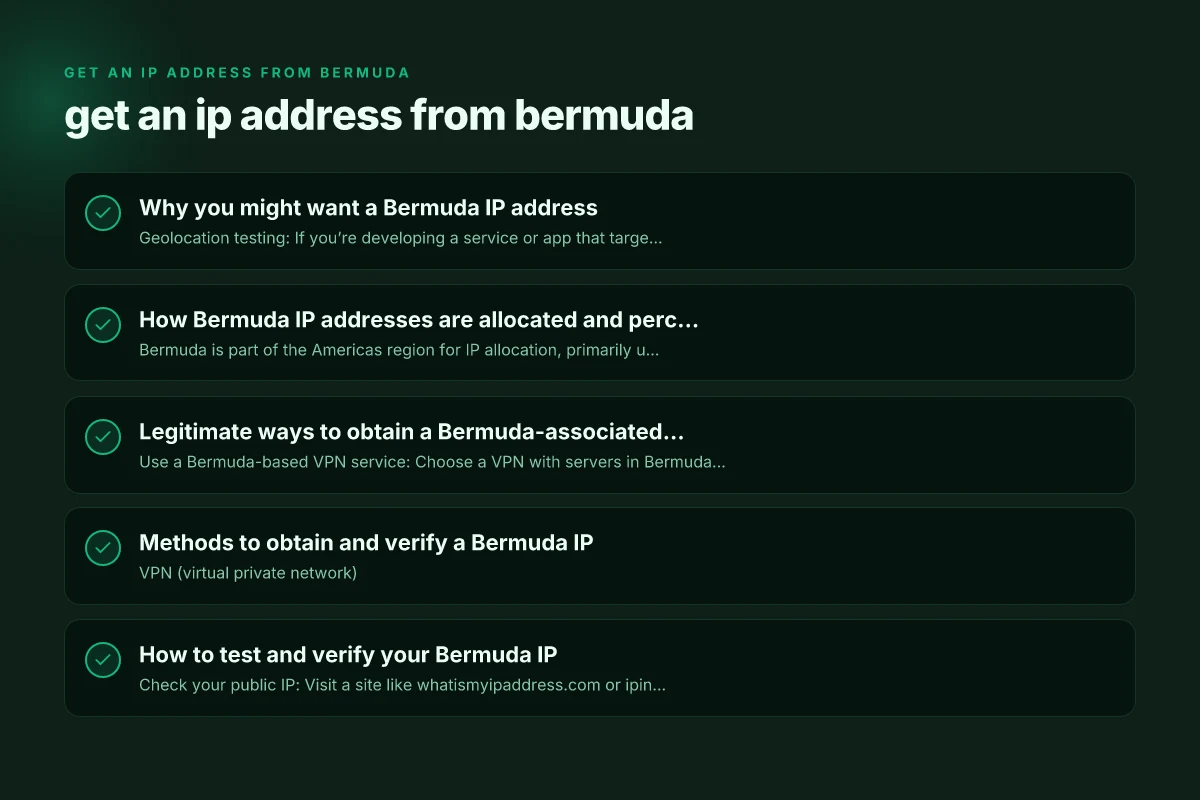
How Bermuda IP addresses are allocated and perceived
- Bermuda is part of the Americas region for IP allocation, primarily using ISPs and hosting providers that manage ranges in Bermuda.
- The public IP you see when you connect to the internet may reflect Bermuda if your connection originates from a Bermuda-based VPN, proxy, or server.
- Some Bermuda IPs come from mobile carriers or enterprise networks. Others may be from Bermuda facilities operated by global providers.
- Geolocation databases map IPs to locations, but accuracy varies. An IP listed as Bermuda may be a nearby or offshore server, and some services use more than one data point to determine location.
What affects Bermuda IP accuracy
- VPN exit node location and provider
- Proxy server location and ownership
- NAT and routing configurations
- Data center versus consumer broadband versus mobile networks
- Updates to geolocation databases
Legitimate ways to obtain a Bermuda-associated IP
- Use a Bermuda-based VPN service: Choose a VPN with servers in Bermuda or that guarantees Bermuda exit routes. Verify their privacy policy, logging practices, and jurisdiction.
- Rent Bermuda-based dedicated or virtual servers: Some providers offer servers physically located in Bermuda. You connect to that server, and your outward IP will be Bermuda.
- Bermuda-hosted cloud services with external access: Some Bermuda data centers provide public IPs for hosted services. Connecting to your service from that host gives Bermuda-origin IPs, though your source IP depends on how you access it.
- Remote desktop or office networks: If you have a Bermuda-based office, you can route your traffic through that network. This typically requires permission and proper VPN or remote access setup.
Methods to obtain and verify a Bermuda IP
- VPN (virtual private network)
- Pros: Easy to use, fast to deploy, strong privacy protections if logging is minimal.
- Cons: Trust in the VPN provider. Potential speed impact.
- Proxy
- Pros: Simple setup for specific apps or browsers.
- Cons: Often less secure. May not encrypt traffic. Some proxies are unstable.
- Cloud/VPS in Bermuda
- Pros: Consistent outbound IP. Can run your own services.
- Cons: More technical setup. Cost. Need to manage server securely.
- Direct ISP or mobile plan routing
- Pros: Real Bermuda network path.
- Cons: Usually harder to obtain for individuals. Higher costs. Terms of service constraints.
How to test and verify your Bermuda IP
- Check your public IP: Visit a site like whatismyipaddress.com or ipinfo.io to confirm the outward IP and approximate location.
- Confirm geolocation details: Some sites show city, region, and country. Use multiple geolocation tests to reduce discrepancies.
- Use DNS-based checks: Run nslookup or dig for Bermuda-based DNS servers to confirm routing can reach Bermuda-specific infrastructure.
- WebRTC leaks: Be aware that WebRTC in browsers can reveal your real IP. Disable or mitigate if you need Bermuda-only exposure.
- Verify consistency: Ensure your Bermuda IP persists for the duration you need, or that it rotates as per your VPN/proxy settings.
A practical comparison: VPN vs. Bermuda-based VPS vs. Bermuda proxy
| Method | Typical use case | Pros | Cons | Cost range (monthly) |
|---|---|---|---|---|
| Bermuda-based VPN | Quick, privacy-friendly Bermuda IP | Easy setup, strong encryption, no server maintenance by you | Trust in provider, possible speed drop | $5–$15 |
| Bermuda-based VPS | Full control, custom apps | Full control, customizable, persistent IP | Setup time, server maintenance, security needs | $10–$50+ |
| Bermuda proxy (HTTP/HTTPS) | App-level Bermuda routing | Simple, low overhead | No encryption by default, limited features | $2–$10 |
Notes:
- Prices vary widely by provider, data center, and service level.
- Some providers offer “ Bermuda exit” guarantees while others merely route traffic through Bermuda-connected networks. Verify service terms.
- Always review privacy policies and data handling practices. A Bermuda IP doesn’t automatically mean your data is private.
Legal and ethical considerations
- Terms of service: Many services prohibit circumventing geo-restrictions or misrepresenting location. Violations can lead to account suspension or legal action.
- Compliance: If you’re handling personal data, ensure your usage complies with data protection laws in Bermuda and your own jurisdiction.
- Privacy risk: VPNs and proxies can log data. Choose providers with transparent logging policies, ideally with independent audits or strong third-party verification.
- Manufacturer and operator legitimacy: Use reputable, well-known providers. Free or dubious services can expose you to malware, data theft, or downstream abuse.
Best practices for a safe, legitimate approach
- Define your goal clearly: Are you testing geo-specific behavior, or trying to access Bermuda-only content? The goal guides the best method.
- Vet providers thoroughly: Look for privacy-focused policies, independent audits, robust security practices, and clear contact information.
- Test in steps: Start with a reputable Bermuda VPN to test your objective before investing in a dedicated Bermuda VPS.
- Secure your setup: Use strong authentication, keep software updated, and monitor for unusual activity.
- Respect terms and laws: Ensure you’re not violating service agreements, licensing restrictions, or local regulations.
Final thoughts and recommendation
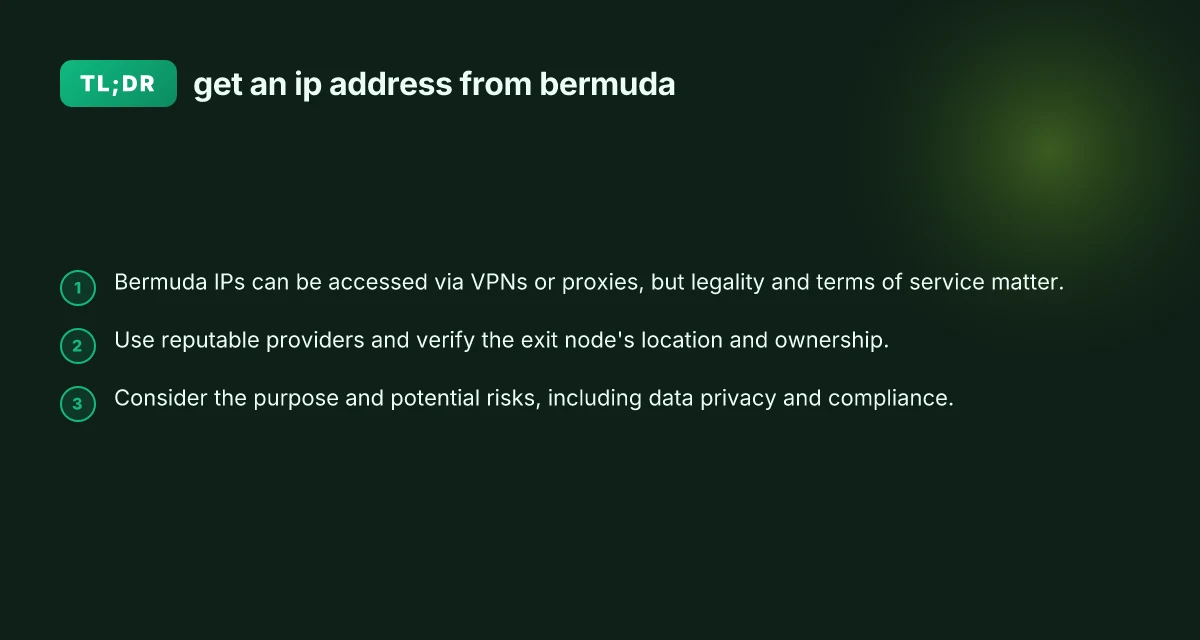
If your aim is a straightforward Bermuda IP for quick testing or geolocation verification, a Bermuda-based VPN is usually the fastest and safest route. It minimizes setup complexity, protects your data in transit, and requires less ongoing maintenance than a dedicated Bermuda VPS. For ongoing projects that require a persistent Bermuda exit or specialized server configuration, a Bermuda VPS gives you full control but demands more setup work and security discipline. Always prioritize reputable providers, understand the privacy implications, and verify your IP location with multiple checks.
If you’re unsure which path fits your needs, start with a trusted Bermuda VPN to validate the requirement. If you determine you need a persistent Bermuda-origin IP or specific network features, consider adding a Bermuda-based VPS in parallel or as a fallback, ensuring you’re compliant and secure every step of the way. Get an IP address from barbados