Get a greek IP address in the UK
Learn practical ways to get a Greek IP address while in the UK, including VPNs, proxies, and smart DNS.
In today’s digital world, there are legitimate reasons to appear as if you’re browsing from Greece while you’re physically in the UK. You might want to access Greek streaming libraries, visit Greek online services, or test geo-specific content. The good news is that there are reliable ways to get a Greek IP address without leaving the UK. Below, we break down the most practical options, their pros and cons, and how to choose the right approach for you.
VPNs with Greek servers
If your goal is to browse as if you’re in Greece, a VPN is often the simplest and most secure route. A VPN (virtual private network) routes your internet connection through a remote server in a country of your choice, masking your real IP address.
How it works
- When you connect to a Greek server, your IP address appears as Greek.
- Your online traffic is encrypted, adding a layer of privacy.
- You can switch servers quickly if you need to access different Greek services.
What to look for in a Greek VPN
- A broad network of Greek servers for reliability and speed.
- Strong encryption and a strict no-logs policy.
- Clear terms about streaming, as some services block VPNs.
- Compatible apps for your devices (Windows, macOS, iOS, Android, routers).
- Reasonable speeds for video streaming and browsing.
Pros and cons
- Pros: Strong privacy, broad compatibility, easy to use, works with most streaming platforms.
- Cons: Some providers may still be blocked by streaming services, there can be a slight speed penalty.
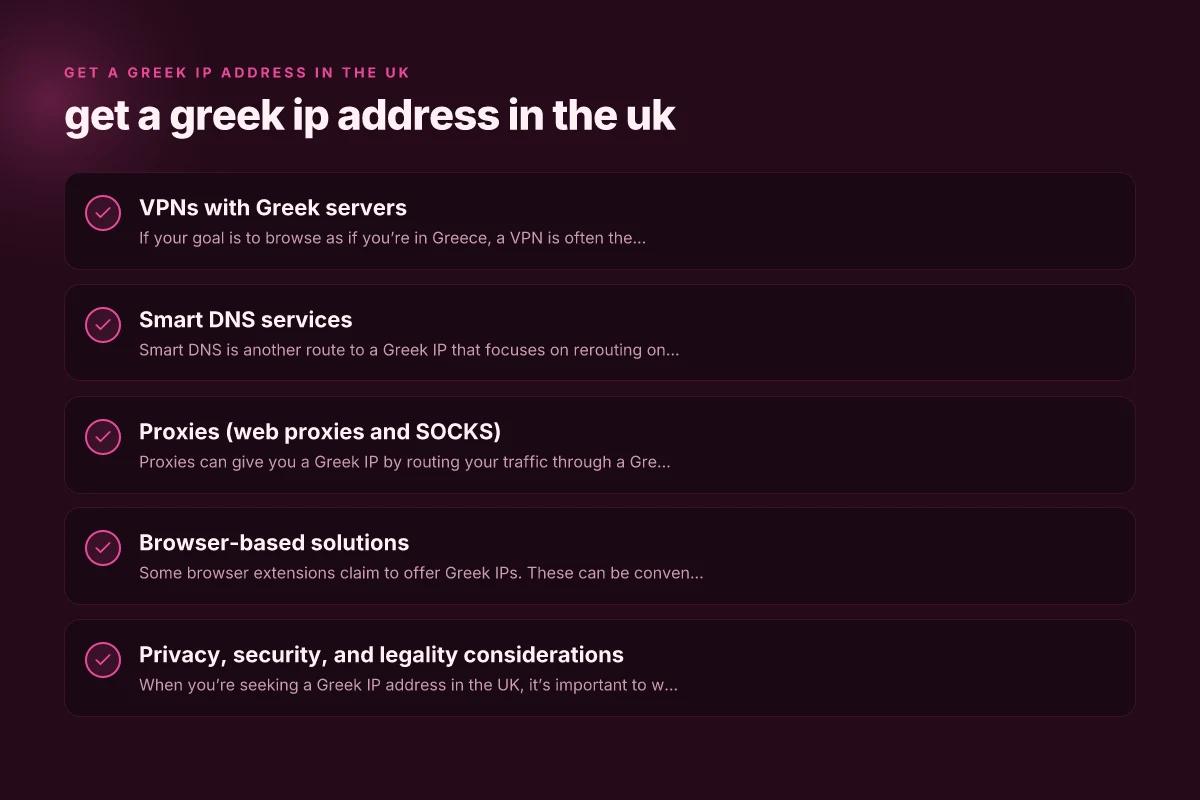
Smart DNS services
Smart DNS is another route to a Greek IP that focuses on rerouting only the essential parts of your connection, typically without encryption. This can deliver faster speeds for streaming, but with fewer privacy protections.
How it works
- Smart DNS alters your device’s DNS requests to appear as if you’re in Greece.
- It doesn’t encrypt traffic the way a VPN does, so your data remains readable by your ISP.
- You usually configure it on devices or routers to support Greek streaming sites.
When to use Smart DNS
- You want higher speeds for HD streaming.
- You don’t need extra privacy protection from a VPN.
- You’re primarily accessing Greek content that relies on geo-restrictions.
Trade-offs
- Pros: Fast performance, easy setup on many devices, good for streaming.
- Cons: No encryption, potential DNS leaks if misconfigured, may still be blocked by some services.
Proxies (web proxies and SOCKS)
Proxies can give you a Greek IP by routing your traffic through a Greek proxy server. They’re often cheaper or free, but come with notable downsides.
How proxies differ from VPNs
- Proxies generally don’t encrypt traffic (unless you use an HTTPS proxy).
- They can be browser-specific or system-wide, depending on the setup.
- SOCKS proxies are versatile but can be slower and less private than VPNs.
Pros and cons
- Pros: Low cost, simple for specific apps or browsers, can unblock some geo-restricted sites quickly.
- Cons: No encryption (privacy risk), uneven reliability, higher risk of data interception on free proxies.
Browser-based solutions
Some browser extensions claim to offer Greek IPs. These can be convenient for quick access, but they’re often less secure and less reliable than full VPNs. Get a greek IP address in finland
What to expect
- Short-term access to Greek content is possible.
- Limited protection. Only browser traffic is affected.
- Greater risk of leaks and poor performance with busy networks.
Best practices
- Only use reputable extensions from trusted sources.
- Avoid entering sensitive data through these extensions.
Privacy, security, and legality considerations
When you’re seeking a Greek IP address in the UK, it’s important to weigh privacy and legality.
- Check the provider’s logging policy: a strong no-logs stance is ideal if privacy matters.
- Understand streaming service terms: some platforms prohibit the use of VPNs and proxies.
- Be aware of data protection regulations: reputable services use robust encryption to protect your data.
- Consider device compatibility: ensure your chosen method works on all devices you plan to use.
A quick comparison table: VPNs, Smart DNS, and Proxies
| Feature | VPN (Greek server) | Smart DNS | Proxy |
|---|---|---|---|
| Encryption | Yes | No (usually) | Mostly No (unless HTTPS) |
| Privacy baseline | High | Moderate | Low to moderate |
| Speed impact | Moderate | Usually low | Variable |
| Streaming reliability | High (with capable provider) | Moderate to high | Variable |
| Setup complexity | Moderate | Simple to moderate | Simple to moderate |
| Best use case | General privacy, streaming Greece | Fast streaming access to Greek sites | Quick, app-specific access |
How to choose the right option for you
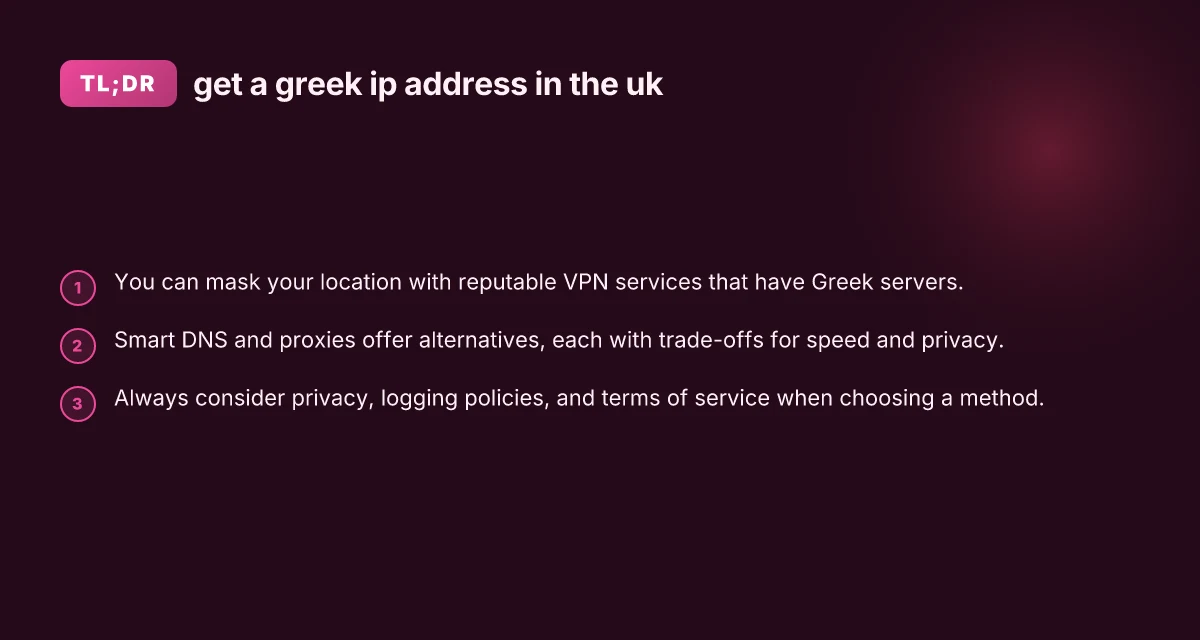
- For secure, all-round access: choose a reputable VPN with Greek servers that explicitly supports streaming.
- For the fastest streaming experience: consider Smart DNS, especially if encryption isn’t a priority.
- For quick, lightweight access to a single site: a reliable proxy or browser extension can be enough, but be mindful of privacy limitations.
- If privacy is a primary concern: prioritize VPNs with strong encryption, a transparent privacy policy, and independent audits if available.
How to set up a Greek IP with a VPN (quick-start)
- Pick a reputable VPN provider that lists Greek servers and supports streaming.
- Sign up and download the app for your device.
- In the app, select a Greek server location.
- Connect and test your IP address using a site like whatismyipaddress.com to confirm Greece appears on the outbound IP.
- Open the Greek streaming service or site you want to access and enjoy, keeping in mind any service-specific restrictions.
- If you experience buffering, try a different Greek server or enable a lighter encryption profile if available.
Common pitfalls and how to avoid them
- VPNs being blocked by streaming services: rotate server locations and ensure your VPN is known to work with the service you’re using.
- DNS leaks with Smart DNS: use built-in tests or third-party tools to confirm your DNS isn’t leaking your real location.
- Free services: free VPNs or proxies often come with data limits, slower speeds, and questionable privacy practices. Invest in a trusted paid option for reliability and security.
- Device incompatibility: verify that your chosen method has compatible apps for all devices (phones, tablets, PCs, smart TVs, routers).
Final section: recommendation
If you want a dependable, privacy-conscious way to get a Greek IP address in the UK, start with a reputable VPN that has multiple Greek servers and strong streaming support. A VPN provides encryption, privacy protection, and broad compatibility, making it the most versatile choice for regular use. If your priority is ultra-fast streaming and you don’t need encryption, a Smart DNS service is a strong complement or alternative. For quick, small-scale needs, a trusted proxy can work, but proceed with caution regarding privacy and data security. Regardless of the method you choose, verify Greek IP functionality across the specific services you plan to access, and stay mindful of each service’s terms of use.