Get a german IP address in France
A practical guide to obtaining a German IP address while you’re in France, with methods, cautions, and tips.
Getting a German IP address while you’re physically in France is a common need for privacy, accessing German services, or streaming content available in Germany. The basic idea is to route your internet traffic through a server located in Germany, so websites see a German IP address instead of your French one. There are several practical approaches, each with its own pros, cons, and use cases. Below is a straightforward guide to help you decide which method fits your situation, and how to implement it safely and effectively.
Why you might want a German IP address in France
- Access German streaming libraries, news sites, or regional content.
- Use German online services that require a German IP for verification.
- Improve privacy by not presenting your local IP to certain websites.
- Test how a German audience would experience a site or app.
These reasons span personal curiosity, professional needs, and privacy considerations. The core idea is to make the destination site think you’re connecting from Germany, not France.
Methods to get a German IP address
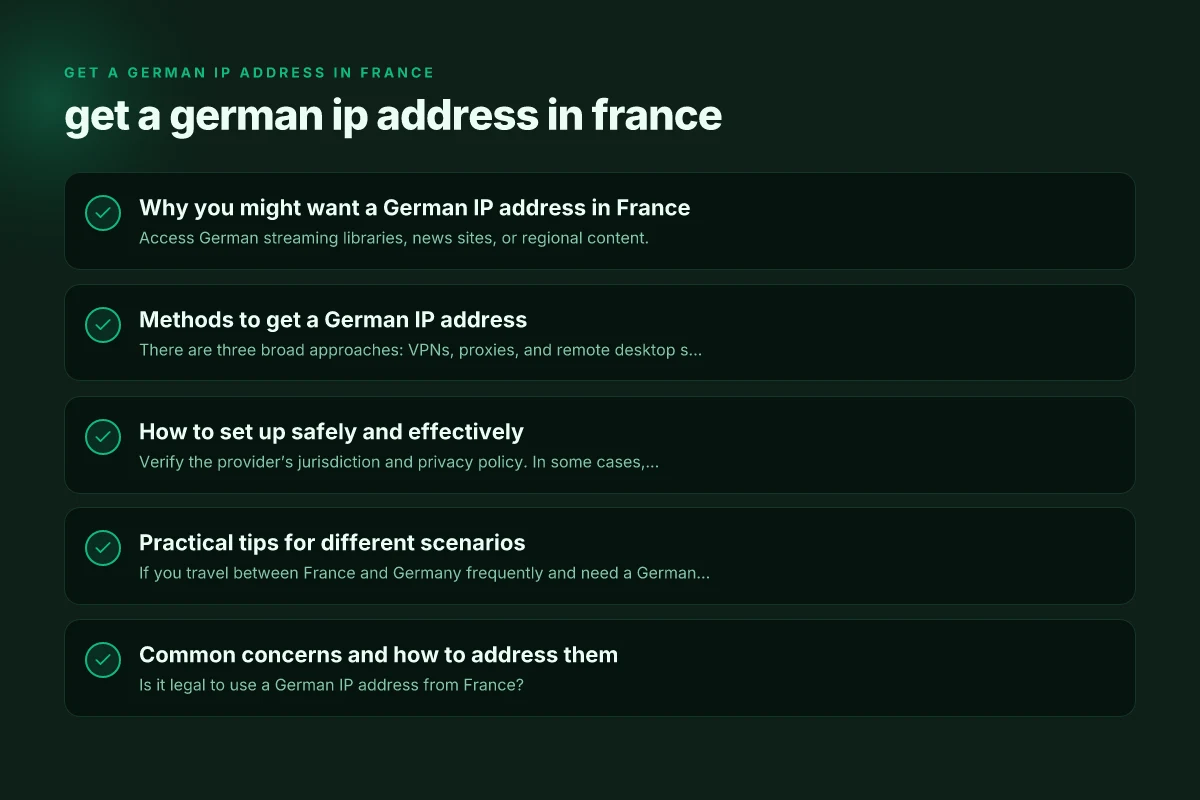
There are three broad approaches: VPNs, proxies, and remote desktop solutions. Each method has different levels of ease, speed, reliability, and privacy implications.
1) VPNs (Virtual Private Networks)
- What it does: A VPN tunnels your traffic to a server in Germany, giving you a German IP for all apps on your device.
- How to use it: Install a reputable VPN app or browser extension. Choose a server located in Germany, then connect.
- Pros:
- Easy to set up and switch servers.
- All traffic is routed through Germany, which is convenient for multiple apps.
- Often good performance and encryption.
- Cons:
- Some services block VPNs. Streaming platforms may detect and block certain servers.
- Trust depends on the provider’s privacy policy and logging practices.
- Best practices:
- Pick a provider with German servers and a clear no-logs policy.
- Test latency and bandwidth to find a fast German server.
- Use the kill switch feature to prevent leaks if the VPN drops.
- Common pitfalls:
- Not all VPNs offer truly German exit IPs. Some “German” servers may be in nearby regions.
- Free VPNs frequently have slower speeds and stronger privacy concerns.
2) German IP via proxies
- What it does: A proxy routes only selected traffic or specific apps through a German intermediary.
- How to use it: Configure the app or system proxy settings to point to a German proxy server or use browser extensions that select a German proxy.
- Pros:
- Can be lighter on device resources than a full VPN.
- Useful when you only need German IP for specific services or browsers.
- Cons:
- Proxies typically lack strong encryption, offering less privacy.
- Reliability varies. Free proxies are often slow or unreliable.
- Some sites detect and block proxy usage more aggressively than VPNs.
- Best practices:
- Prefer SOCKS5 or HTTPS proxies from reputable providers.
- Use proxies only for the traffic you need. Avoid placing sensitive data through unencrypted proxies.
- Combine with HTTPS to add a layer of security.
- Common pitfalls:
- DNS leaks can reveal your actual location if the proxy isn’t properly configured.
- Proxies do not always support all apps or services you use.
3) Remote desktop or cloud desktop in Germany
- What it does: You connect to a computer or virtual desktop located in Germany and use it as your online environment.
- How to use it: Rent a German-based remote desktop or virtual machine, then access it via remote desktop software or a browser.
- Pros:
- Your outbound IP appears as the German host’s IP, which is stable and consistent.
- The traffic between you and the host is encrypted depending on the remote solution.
- Cons:
- Typically more expensive than VPNs or proxies.
- Requires a continuous internet connection and decent upload speeds to feel responsive.
- Best practices:
- Choose reputable cloud providers with German data centers and strong security practices.
- Use a fast protocol (RDP, VNC over VPN, or SSH tunneling) to minimize latency.
- Lock down access with two-factor authentication and strong passwords.
- Common pitfalls:
- Higher latency can make interactive tasks less smooth.
- Not ideal for streaming high-bandwidth content unless the remote host has ample bandwidth.
Quick comparison
- VPN: All traffic via German server. Good for general use. Strong privacy if no-logs policy. May be blocked by some services.
- Proxy: Targeted traffic through a German server. Lower overhead. Weaker privacy, higher risk of leaks.
- Remote desktop: German-based environment. Stable IP. Higher cost. Best for specialized workflows or software testing.
Table: when to choose which approach
| Method | Primary Use Case | Privacy Level | Speed & Latency | Cost |
|---|---|---|---|---|
| VPN | General use, streaming, multiple apps | High (with good provider) | Medium-High | Moderate |
| Proxy | Specific apps or browsers | Moderate to Low | Variable | Low to Moderate |
| Remote Desktop | Software testing, persistent German env | High (isolated env) | Variable (depends on host) | High |
How to set up safely and effectively
- Verify the provider’s jurisdiction and privacy policy. In some cases, you’re entrusting your data to a company outside your country, so understand what they log and retain.
- Look for German IPs that are backed by real servers in Germany rather than virtualized or shared IPs that could be flagged.
- Check the service’s compliance with data protection standards (e.g., GDPR). This matters if you’re handling sensitive information.
- Test speeds with speed tests to a German server from your location. Compare latency and throughput to ensure acceptable performance for your needs.
- Prefer providers that publish transparent speed and reliability benchmarks and offer a money-back guarantee or trial period.
- If you’re streaming, check the service’s terms and the provider’s ability to unblock regional content. Some platforms actively ban VPN or proxy usage.
- Be mindful of DNS and IPv6 leaks. Ensure you’re not leaking your actual location due to misconfiguration.
- Protect your devices with updated software, strong passwords, and two-factor authentication where available.
Practical tips for different scenarios
- If you travel between France and Germany frequently and need a German IP often:
- A paid VPN with multiple German servers and reliable performance is usually the simplest solution.
- Prefer a service with robust customer support, a clear privacy policy, and transparent blocking information.
- If you only need a German IP for a short task (like verifying a German storefront):
- A temporary proxy service or a browser extension can be convenient. Keep in mind privacy considerations and potential leakage.
- If you’re testing software across Germany and other regions:
- A remote desktop or cloud desktop can give you a stable German environment, especially for desktop apps or testing workflows that require a German IP consistently.
Common concerns and how to address them
- Is it legal to use a German IP address from France?
- In most cases, using a VPN or similar service to route your traffic through another country is legal for personal use. Check local regulations and the terms of service for any apps you use.
- Will streaming work with a German IP?
- Some streaming services actively block VPNs and proxies. If your goal is to access German libraries, you may need to try different servers or providers that specialise in unblocking content.
- Could my real location still be exposed?
- DNS leaks, WebRTC leaks in browsers, and IPv6 leaks can reveal your real location. Use a VPN with a kill switch, disable WebRTC in your browser, and ensure IPv6 is managed properly.
- How do I know if a German IP is truly in Germany?
- Reputable providers publish information about their server locations and perform ongoing IP address checks. You can test your current IP on a site like whatismyipaddress.com to confirm the detected location.
Bottom line and recommendations
If your goal is to get a German IP address in France, start with a reliable VPN service that offers German servers, strong privacy policies, and robust performance. A VPN provides the most straightforward, versatile solution for general use, streaming, and quick switching between regions. If you only need German access for specific apps or a single task, a high-quality proxy with careful configuration can suffice. For highly specific workflows or software testing that requires a controlled German environment, a remote desktop solution may be worth the extra cost. Get a german IP address
Recommendation:
- For most users: choose a reputable VPN with multiple German servers, clear privacy terms, and honest performance guarantees. Ensure you enable a kill switch and test with your typical tasks.
- For targeted access or lighter use: consider a trusted proxy service or browser extension with careful security settings and explicit privacy assurances.
- For specialized, consistent German testing: opt for a German-based remote desktop or cloud server with strong security practices and a robust network.
If you’d like, tell me your primary use case (streaming, business access, testing, or privacy) and your acceptable budget, and I’ll suggest specific providers and a step-by-step setup tailored to you.