Affiliate disclousure
A clear guide to affiliate disclosure, why it matters, and how to implement it properly across platforms.
Affiliate disclosure is not just a legal formality, it’s a trust-building practice that protects both creators and audiences. If you promote products, services, or brands and receive compensation, readers have a right to know. This article explains what affiliate disclosure is, when you need it, how to write it, and practical tips for making it effective across platforms.

What affiliate disclosure means
A plain definition
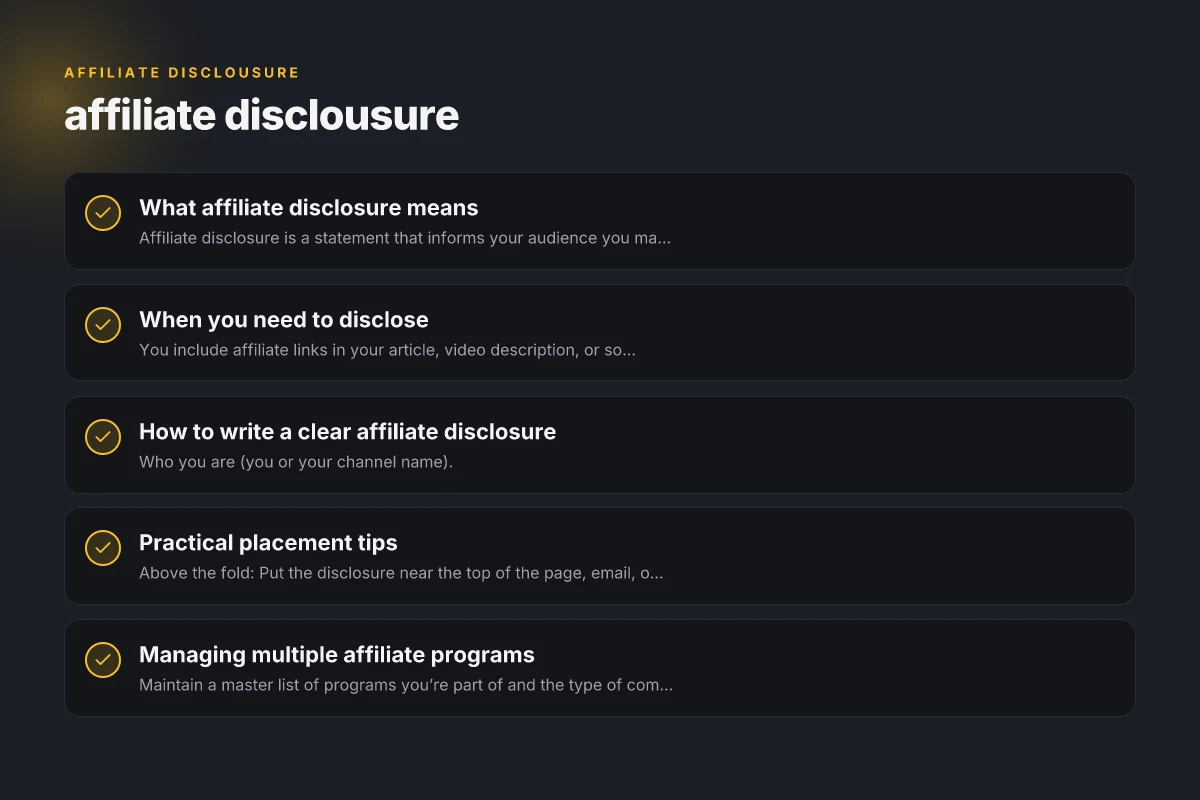
Affiliate disclosure is a statement that informs your audience you may earn a commission or other compensation when they take a specific action (like clicking a link or making a purchase) as a result of your content.
Why it matters
- Legal compliance in many jurisdictions (including the FTC in the United States and similar bodies elsewhere).
- Maintains trust with your audience.
- Helps protect you from accusations of hidden sponsorships or biased reviews.
- Improves clarity for readers who might otherwise misinterpret recommendations.
When you need to disclose
General scenarios
- You include affiliate links in your article, video description, or social media post.
- You are paid to promote a product or service.
- You receive free products in exchange for coverage and you mention it in your content.
Platform-specific expectations
- Blog posts: disclose near the top of the post and beside affiliate links.
- YouTube: disclose in the video description and/or within the video itself.
- Instagram/TikTok: use caption disclosures and, if possible, overlay text in the video.
- Newsletters: include a disclosure at the top or bottom of the email body.
Timing rules
Disclosures should be present at the time a reader first encounters your content, not buried in a footer or only in a separate page. Update disclosures whenever the relationship or program changes.
How to write a clear affiliate disclosure
What to include
- Who you are (you or your channel name).
- The nature of the relationship (affiliate link, sponsored post, paid partnership).
- What that means for the reader (you may earn a commission if they purchase or take a defined action).
- Any conditions or limitations (e.g., “at no extra cost to you”).
- A call to action to learn more if needed (optional).
Sample templates
- Short and sweet: “This post contains affiliate links. If you buy through these links, I may earn a small commission at no extra cost to you.”
- Transparent and formal: “I participate in [Program Name] and I may earn commissions from qualifying purchases. This helps support my work.”
- For social posts: “Affiliate link. I may receive a commission for purchases made through this link.”
Language guidelines
- Use plain language, not legalistic jargon.
- Avoid vague terms like “may or may not be compensated” without context.
- Prefer active voice: “I earn a commission when you purchase through this link.”
Practical placement tips
Where to place disclosures
- Above the fold: Put the disclosure near the top of the page, email, or video description.
- With the link: If you’re including affiliate links within a paragraph, place the disclosure close to the first link.
- On social media: Use platform-native disclosures (e.g., hashtags like #ad, #affiliatelink) along with a clear sentence.
Visuals and formatting
- Use bold or a separate line for the disclosure so it’s easily skimmable.
- In videos, mention the disclosure verbally and add on-screen text.
- For longer posts, repeat a brief disclosure near the beginning and near the affiliate links.
Examples by platform
- Blog post: “Disclosure: This post contains affiliate links. If you click and make a purchase, I may earn a commission at no extra cost to you.”
- YouTube: “This video contains affiliate links. I may earn a commission for purchases made through these links at no extra cost to you.”
- Instagram: “Paid partnership with [Brand]” or “Affiliate link in bio. I may earn a commission.”
Managing multiple affiliate programs
How to keep disclosures accurate
- Maintain a master list of programs you’re part of and the type of compensation.
- Update disclosures when a program ends or begins.
- Clearly differentiate if some links are affiliate while others are not.
Comparison: affiliate vs non-affiliate links
| Link type | Source of compensation | Disclosure requirement | Example wording |
|---|---|---|---|
| Affiliate link | You earn a commission | Required or strongly advisable | “This post contains affiliate links; I may earn a commission.” |
| Non-affiliate link | No compensation | Generally not required | “Link to product” (no disclosure needed) |
| Sponsored post | Brand pays you | Required | “Sponsored by [Brand]” or “Partner post” |
Documentation and audits
- Keep receipts and program terms in case of questions.
- Periodically audit old content to ensure disclosures remain accurate.
Ethics and best practices
Be honest about your motivations
Readers benefit from knowing when a recommendation is influenced by compensation. Honesty fosters long-term trust.
Review and revise
As programs change or as platform guidelines evolve, update your disclosures accordingly. About web based proxies and the advantages of using a paid proxy server
Balance disclosure with user experience
Aim for disclosures that are clear but not jarring. Strive for a natural integration that doesn’t derail the reading experience.
The legal landscape (high-level)
- United States: FTC guidelines emphasize transparency. Disclosures should be clear and conspicuous and near the endorsements.
- European Union: Rules around advertising and consumer protection apply. Disclosures should be obvious and in the user’s language.
- Other regions: Many countries have their own consumer protection and advertising standards. Stay informed about local requirements.
Note: This article provides general guidance and does not constitute legal advice. If you operate in a regulated environment or have questions about compliance, consult a legal professional.
How to implement a disclosure routine
Create a disclosure checklist
- Identify all content that includes affiliate links or sponsorships.
- Confirm the exact relationship and compensation type for each item.
- Draft a clear, audience-friendly disclosure text.
- Place the disclosure prominently in the content.
Build templates for consistency
- Have standard disclosure language ready for posts, videos, and newsletters.
- Customize only where necessary to reflect specific programs.
Automate where possible
- Use platform features to tag affiliate links or to add a disclosure banner where supported.
- Consider content management processes that prompt you to add disclosures before publishing.
Final recommendations
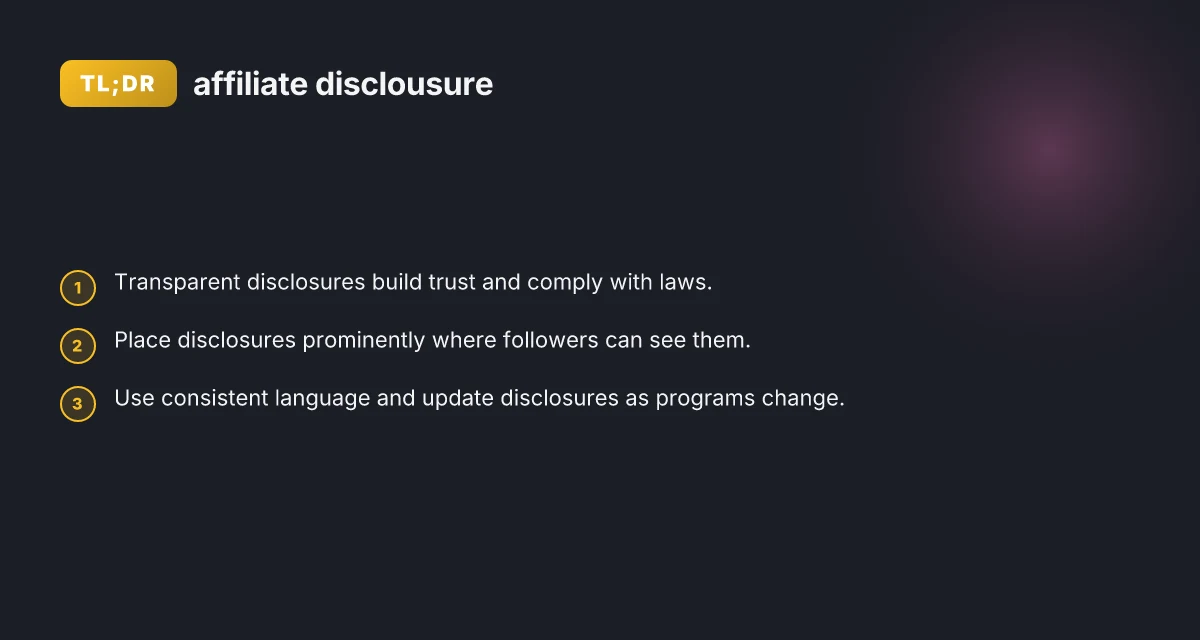
- Start with transparency: always disclose your affiliate relationships clearly.
- Place disclosures where readers will see them first, not after they finish reading.
- Use simple, direct language tailored to your audience.
- Update your disclosures whenever your affiliate relationships or programs change.
- Treat disclosures as part of your content quality, not as an afterthought.
If you’re just starting to use affiliate links, draft a simple disclosure now and place it at the top of your posts. As you publish more content, refine your language and placement based on audience feedback and platform guidelines. Consistency and honesty in disclosure not only protect you legally but also strengthen your credibility with your community.